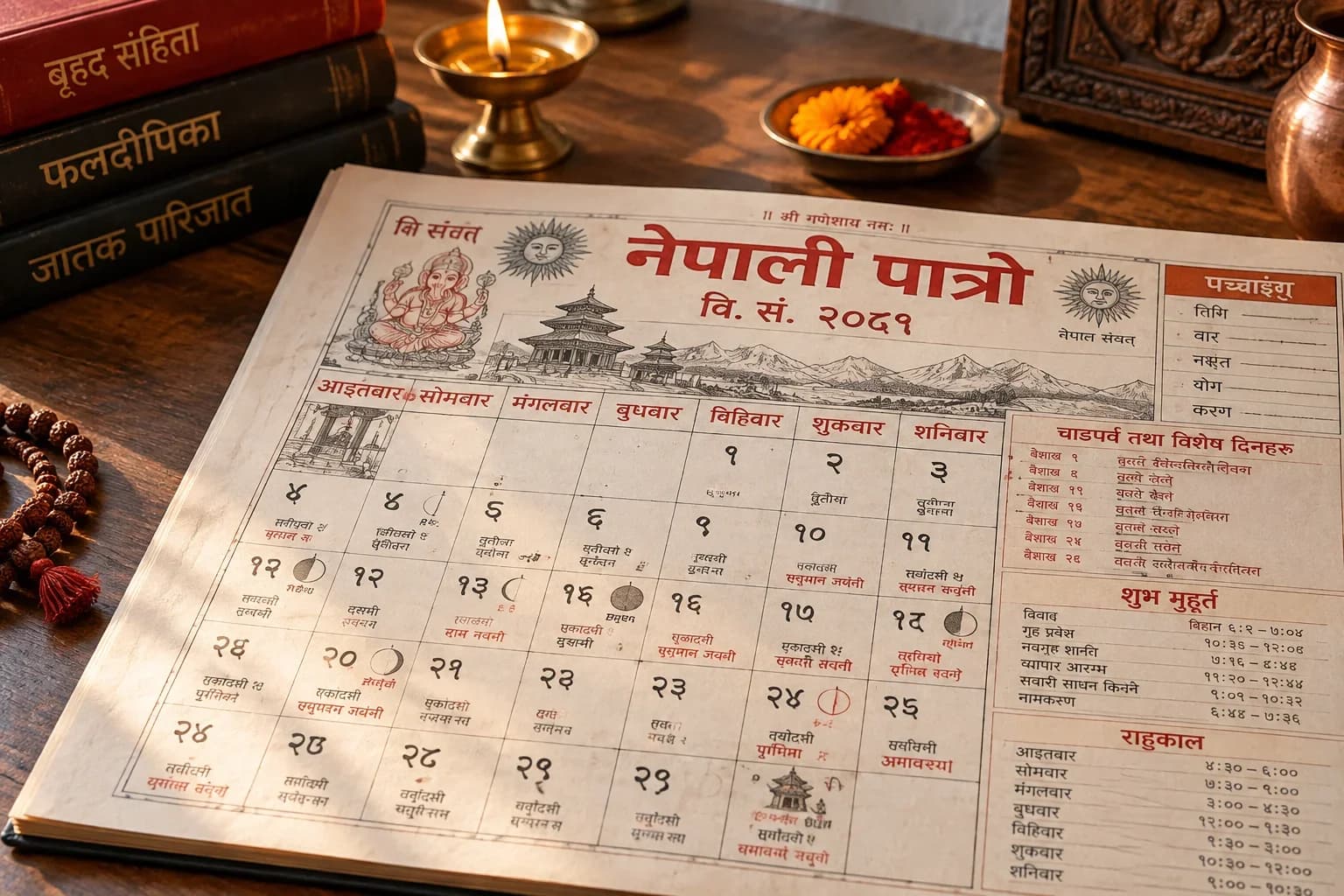
The first time you look at a Janma Kundali, it may not look like something that can be read at all.
There may be a large square divided into diamonds and triangles. Some compartments contain numbers. Others contain short forms such as Su, Mo, Ma, Ju, Sa, Ra or Ke. Somewhere you may see Lagna written, or simply La. Beside the planets there may be degrees and minutes. Another page may contain a table of Dashas. If the horoscope was prepared traditionally in Nepal, the entire record may be handwritten in Devanagari inside an old china that has been kept by the family since the person's birth.
At first glance, it can feel less like a chart and more like a code.
That reaction is perfectly understandable.
A Janma Kundali compresses several layers of information into a surprisingly small space. What looks like one diagram may be showing the relationship between the twelve Bhavas, twelve Rashis, nine Grahas, Lagna and their positions at a particular moment of birth.
The difficulty for a beginner usually comes from trying to interpret all of those layers at once.
The better approach is much simpler:
first learn what you are looking at.
Before asking whether Saturn is favourable, whether a particular Yoga is present, or what the chart supposedly says about marriage, profession or wealth, we need to understand the structure in front of us.
A Kundali has a grammar.
Once that grammar becomes familiar, the chart stops looking like a collection of mysterious boxes.
A familiar object in many Nepali families
In Nepal, a birth horoscope may be called a Janma Kundali, Janma Patrika, or simply a china — चिना.
The form varies considerably.
A modern Kundali produced by astrology software may be printed neatly with separate pages for planetary positions, Nakshatra, Vimshottari Dasha, Navamsha and other divisional charts.
An older family china may look completely different.
It may contain handwritten Sanskrit or Nepali terms, numerical calculations, planetary abbreviations, the child's birth Tithi and Nakshatra, the initial syllable traditionally suggested for naming, Dasha information and several charts on folded sheets of paper.
Sometimes the document survives for decades.
A person may not know how to read it, yet the family still keeps it carefully.
That makes the china an interesting object. It is at once a calculation, a religious-cultural record and, for families who use Jyotish, a map to which people may return at different stages of life.
A family may open it when discussing marriage.
Someone may take it to a Jyotishi during a difficult period.
It may be consulted while trying to understand a Graha Dasha.
Or it may simply stay wrapped inside a cupboard until someone in the next generation becomes curious enough to ask:
What is actually written here?
That question is where our reading begins.
Do not begin by predicting
One of the most common mistakes in learning Jyotish is beginning with prediction.
A beginner sees:
Shani in the seventh house.
Then immediately searches:
“Saturn in seventh house meaning.”
A search result may declare that marriage will be delayed, the spouse will be older, relationships will be difficult, marriage will fail, or some other fixed result.
Another website may say something completely different.
The problem began before either interpretation was read.
We tried to interpret one piece of information before understanding the chart around it.
Even if Saturn really is in the seventh Bhava, several questions remain unanswered.
Which Lagna is rising?
Which Rashi occupies the seventh Bhava?
Which houses does Saturn rule in this particular Kundali?
What is Saturn's condition?
Is it in its own sign, a friendly sign, an inimical sign, exaltation or debilitation?
Which Grahas are with it?
Which Grahas aspect it?
Where is the seventh lord?
What is happening in the Navamsha?
Which Dasha is operating?
And, perhaps most importantly, what question are we actually trying to answer?
Without that context, “Saturn in the seventh” is only one observation.
It is not yet a judgement.
This principle will return throughout this guide:
A placement is information. Interpretation comes from relationships.
That distinction is one of the first habits worth developing in Jyotish.
Think of the Kundali as a map
There is a useful way to approach a birth chart when you are new to it.
Imagine looking at a map of Kathmandu without knowing what any of the symbols mean.
A line might represent a road.
Another line might be a river.
A shaded area may be a park.
A small icon may indicate a temple.
A number may identify a highway.
If you decide that every line means the same thing, the map becomes useless.
A Kundali works in a similar way.
Different things shown in the same diagram represent different kinds of information.
For example:
A Bhava tells us which area of life we are examining.
A Rashi tells us which zodiacal division occupies that Bhava.
A Graha is placed within that Rashi and Bhava.
The lord of the Rashi creates a connection with another part of the chart.
Lagna determines where the entire house structure begins.
Later, Nakshatra, Dasha, Drishti, Varga and other factors add further layers.
None of these terms should be thrown together as though they mean the same thing.
Learning Jyotish begins by separating them.
The chart is not the sky itself
It is also useful to understand what the diagram actually is.
A Kundali is not a picture of the sky.
If Mars appears in one triangular compartment and Jupiter appears in another, those little triangles are not literal pieces of the heavens.
The chart is a symbolic layout used to organise astronomical positions for astrological interpretation.
At the moment of birth, the zodiac has a particular orientation relative to the local horizon. One part of the zodiac is rising in the east. The Sun, Moon and planets occupy particular zodiacal longitudes. Jyotish calculations place those positions into the structure used by the horoscope.
The diagram then gives us a compact way to work with that information.
This distinction becomes important later because a beginner may assume that the visual distance between two planets on the printed chart represents their actual angular distance.
It does not necessarily do so.
Two planets written far apart within the same box may be only a few degrees apart.
Two planets in neighbouring boxes may actually be nearly 30 degrees apart.
For precise relationships, we eventually need their degrees, not merely the drawing.
That is why a serious Kundali normally includes more information than the central chart alone.
Three things must not be confused
Before going any further, remember these three words:
Bhava
The house.
Rashi
The zodiac sign.
Graha
The astrological celestial factor placed within the chart.
These are different things.
This sounds simple now, but confusing them causes many beginner mistakes.
Suppose one compartment represents the seventh Bhava.
Inside it is the number 10.
Saturn is also written there.
There are already three separate facts:
- it is the seventh Bhava;
- Rashi number 10, Makara, occupies it;
- Saturn is placed there.
And then another fact appears:
Saturn also rules Makara.
Now we have a relationship between the occupant, the sign and the house.
This is where a Kundali begins to come alive.
But we will not rush there yet.
The first task is simply to recognise that house, sign and planet are three separate layers of the same chart.
Why the North Indian chart can confuse beginners
For this guide, we will mainly use the North Indian-style horoscope, because this form is commonly encountered across northern India and Nepal.
It has a very important visual rule:
The positions of the Bhavas remain fixed in the diagram. The Rashis occupying them change according to the Lagna.
This is why the numbers written inside a North Indian chart often confuse someone seeing it for the first time.
If you see:
1
inside a compartment, your natural reaction may be:
“That must be the first house.”
Not necessarily.
In a North Indian Kundali, the number 1 ordinarily indicates Mesha Rashi — Aries.
Similarly:
2 = Vrishabha
3 = Mithuna
4 = Karka
and so on until:
12 = Meena.
The house is determined by its position in the diagram.
The number written there tells us the Rashi occupying that house.
This single distinction solves a surprising amount of beginner confusion.
Later we will learn the full chart layout visually and practise locating all twelve Bhavas.
For now, remember only this:
In a North Indian Kundali, do not automatically read the numbers as house numbers.
They usually identify the Rashis.
What are all those abbreviations?
A modern Kundali often uses shortened names for the Grahas.
You may see something like:
Su
Mo
Ma
Me
Ju
Ve
Sa
Ra
Ke
These generally indicate:
Su — Surya, the Sun
Mo — Chandra, the Moon
Ma — Mangala, Mars
Me — Budha, Mercury
Ju — Guru or Brihaspati, Jupiter
Ve — Shukra, Venus
Sa — Shani, Saturn
Ra — Rahu
Ke — Ketu
Different software may use slightly different abbreviations.
A traditional Nepali or Sanskrit horoscope may use Devanagari instead.
You might encounter forms such as:
सू / सूर्य
च / चन्द्र
मं / मंगल
बु / बुध
गु / गुरु
शु / शुक्र
श / शनि
रा / राहु
के / केतु
The exact handwriting or abbreviation can vary from one astrologer or document to another.
That is another reason an old china can appear more difficult than a computer-generated Kundali even when both represent the same basic information.
And what is “La”?
You may also see:
La
or:
Asc
or a notation indicating Lagna.
This is not another planet.
It marks the Ascendant—the zodiacal point rising on the eastern horizon for the specific time and place used to calculate the chart.
Lagna is so important that we will devote an entire section to it.
For now, think of it as the starting point from which the natal chart is organised.
If you cannot identify the Lagna, you should not begin interpreting the houses.
This is one of the most important practical rules in the whole guide.
What about the degrees?
Beside a planet you may see something such as:
Ju 18°24′
or:
Sa 03°11′
Those numbers are not decoration.
They tell us where within a 30-degree Rashi the Graha is positioned.
Later, those degrees help us determine matters such as:
- exact planetary position;
- Nakshatra;
- Nakshatra Pada;
- closeness of conjunctions;
- divisional placements;
- combustion;
- certain strength calculations;
- and the precise degree of Lagna.
At the beginner stage you do not need to calculate all of these by hand.
But you should develop one habit immediately:
Do not mentally erase the degrees when reading a chart.
Two people may both have Jupiter in the same Rashi, yet one may have Jupiter at 1° and another at 28°. At the most basic sign level the placement is the same, but several finer calculations can be different.
Jyotish becomes increasingly precise as we move from broad placement toward degrees.
Why birth time and place appear everywhere
A Janma Kundali is calculated for a particular moment at a particular location.
That is why a horoscope needs more than a birthday.
Usually the essential birth information is:
date of birth
time of birth
place of birth
The place matters because the horizon depends on where the observer is located.
The time matters because the eastern horizon changes continuously as Earth rotates.
This affects the Lagna.
Official Indian astronomical Panchanga tables, for example, give different beginning times for Lagnas and provide location corrections because Lagna timing depends on geographical position.
This has an immediate practical consequence.
Two people born on the same date need not have the same Kundali.
Even two people born in the same hospital on the same day may have different Lagnas if enough time separates their births.
And if birth time is uncertain, that uncertainty needs to be taken seriously rather than hidden.
Later in this guide we will examine what can change when the recorded time is approximate.
A Kundali is a snapshot—but Jyotish does not stop there
The natal chart freezes one astronomical moment:
birth.
But life continues.
The planets continue moving.
This is why Jyotish does not rely only on the static Janma Kundali.
Later, an astrologer may study:
Dasha — planetary periods used in traditional timing.
Gochar — current planetary transits.
Vargas — divisional charts derived mathematically from the natal positions.
Nakshatra — particularly important for lunar position and Dasha calculation.
These techniques do not replace the birth chart.
They build upon it.
A useful beginner analogy is:
The Janma Kundali gives the foundation. Timing techniques show when particular parts of that foundation become especially relevant within the astrological system.
This is why jumping directly to today's transit or a running Mahadasha without understanding the natal chart can create confusion.
First learn the foundation.
There is more than one way to draw the same horoscope
You may eventually encounter a chart that looks nothing like the North Indian diamond-shaped form.
South Indian charts generally use a rectangular grid.
Eastern Indian/Bengali traditions use another visual arrangement.
Modern software may also show a circular Western-style zodiac wheel.
This does not automatically mean they represent different skies or different birth data.
Often they are simply different visual conventions for arranging the same underlying planetary positions.
In this guide we will stay mainly with the North Indian/Nepali-style chart so that the visual language remains consistent.
Once you understand the underlying principles—Rashi, Bhava, Graha and Lagna—moving between chart styles becomes much easier.
What you should look for the first time you open a Kundali
Do not try to interpret anything yet.
Instead, look at the chart and ask only these questions:
Can I find the Lagna?
Can I identify the first Bhava?
Can I see which Rashi occupies it?
Can I recognise the Graha abbreviations?
Are planetary degrees shown?
Is there a separate Navamsha chart?
Is the Moon's Nakshatra written somewhere?
Are Dasha tables included?
That is enough for the first inspection.
You are taking inventory.
An experienced mechanic does not diagnose an engine by touching the first visible part. A physician does not reach a conclusion from one line of a report. Likewise, the useful first step in Jyotish is observation before interpretation.
Four layers we will learn to read
As we proceed through this guide, think of the Kundali as being built in layers.
Layer One — The framework
The twelve Bhavas.
This tells us where in the structure we are looking.
Layer Two — The Rashis
The zodiac signs occupying those houses.
This tells us which Rashi governs each part of the chart and therefore identifies the relevant house lord.
Layer Three — The Grahas
The Sun, Moon, Mars, Mercury, Jupiter, Venus, Saturn, Rahu and Ketu.
This tells us which Grahas occupy and influence different parts of the horoscope.
Layer Four — Relationships and timing
Lordship, dignity, Drishti, conjunctions, Nakshatra, Vargas, Dasha and Gochar.
This is where actual astrological interpretation becomes much deeper.
A beginner often tries to start with Layer Four.
We are going to do the opposite.
We will build from the bottom upward.
The first rule of this guide
There is one sentence worth remembering before continuing:
Do not ask what a placement means until you are certain what the placement actually is.
That may sound obvious.
In practice, it prevents a great deal of bad astrology.
Someone who mistakes a Rashi number for a house number may interpret the wrong Bhava.
Someone who ignores Lagna may assign the wrong house lord.
Someone who sees one conjunction but ignores the degrees may exaggerate its closeness.
Someone who reads Saturn as automatically harmful may miss its actual role in the chart.
And someone who begins with a prediction may never learn how the prediction was supposed to be derived.
Our purpose here is different.
By the end of this guide, you should not merely be able to recognise a Kundali.
You should be able to look at one and know what to examine first, what to examine next, what questions to ask, and when there is not yet enough information to form a conclusion.
That is a much better foundation for learning Jyotish than memorising hundreds of isolated predictions.
Before moving to the next section
Take any North Indian-style Kundali—your own, a family member's, or simply a sample chart.
Do not search for its predictions.
Just look at it.
Find:
- the outer shape;
- the twelve compartments;
- the Rashi numbers;
- the Graha abbreviations;
- Lagna;
- the planetary degrees, if shown;
- and any additional charts or Dasha tables printed beside it.
Once you can identify these pieces without trying to interpret them, the chart has already become less mysterious.
Now we can begin properly.
The next question is:
What exactly is a Janma Kundali, and how is it calculated from birth date, time and place?