Meaning, Origins and How It Is Read
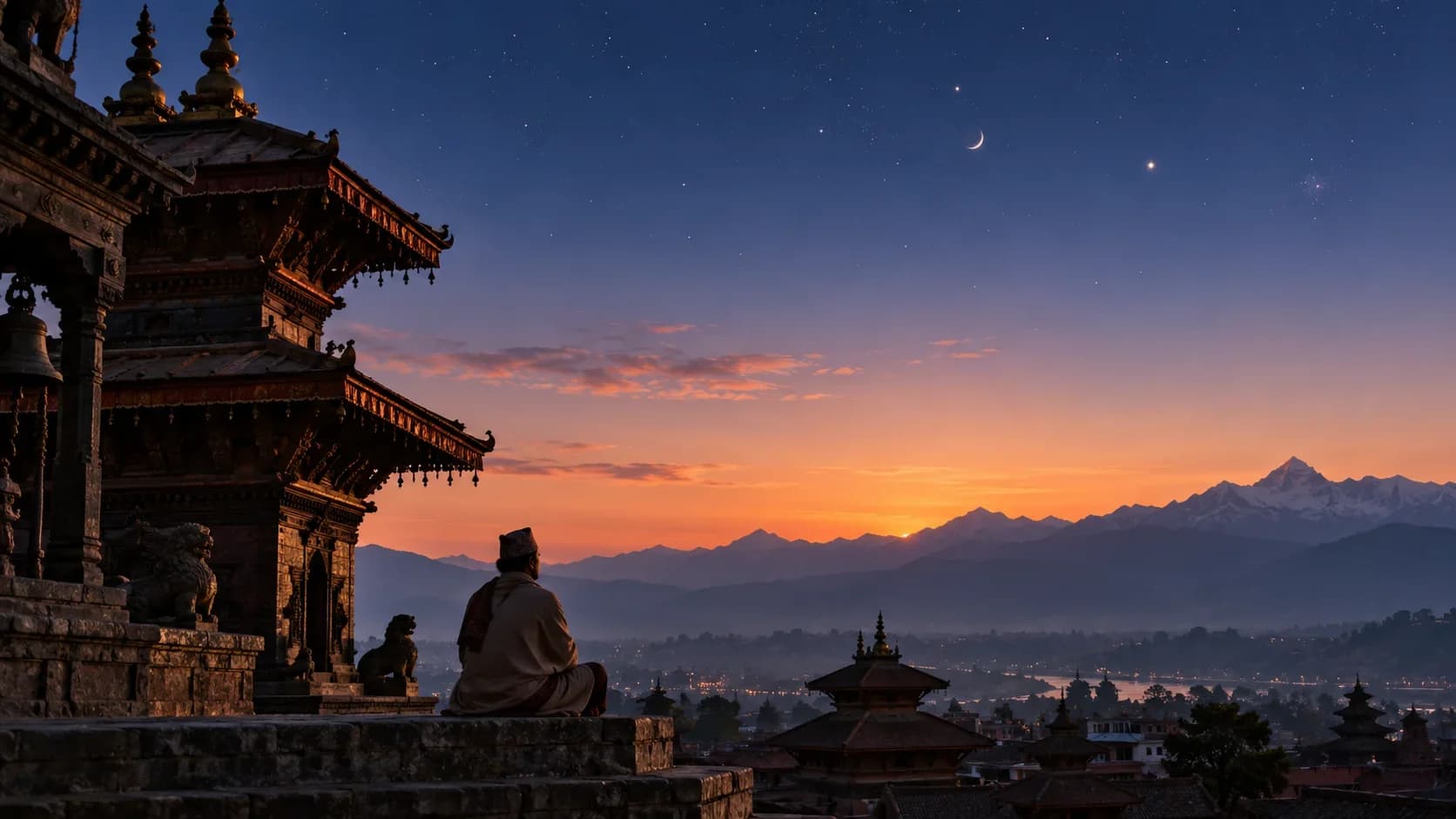
In Nepal, Jyotish does not always enter our lives through a horoscope.
Sometimes it arrives as a date circled in a patro. Sometimes an elder asks whether the sait is favourable before a marriage. A family may consult a jyotishi after the birth of a child, prepare a china or janma kundali, look at the birth nakshatra before naming the child, or check an auspicious period for bratabandha, marriage, entering a new house or beginning an important journey.
Even people who have never formally studied astrology may know their rāshi. They may have heard the words graha dasha, Shani, Rahu, nakshatra, lagna or muhurta around the family home.
This is one reason Jyotish is difficult to explain simply.
It is not only a method of reading a birth chart. Historically, the word covers a much wider field: observing and calculating the movements of heavenly bodies, reckoning time, constructing calendars, determining ritual timings, studying eclipses and planetary positions, and, in later traditions, interpreting birth charts and other astrological configurations.
In Nepal and the Indian subcontinent, these different strands have lived beside one another for centuries.
To understand Jyotish properly, it helps to begin before prediction.
It helps to begin with time.
What does “Jyotish” actually mean?
The Sanskrit word is Jyotiṣa — ज्योतिष.
It is related to jyotis, a word carrying meanings connected with light, a luminous body, a star or heavenly luminary. Sanskrit dictionaries also use jyotiṣa for the study of the movements of celestial bodies and the divisions of time associated with them.
This is worth understanding because a popular modern translation calls Jyotish simply the “science of light.”
The phrase is attractive, and it can have philosophical meaning, but it should not replace the more precise historical sense. Jyotish dealt with the heavenly lights because their cycles provided a way to measure and organise time.
The Sun marks the day and the year.
The Moon gives us the changing lunar phases.
Its relationship with the Sun produces the tithi.
The Moon's passage through the stellar background gives the nakshatra.
Sunrise differs by location and season.
The planets appear to move through the zodiac.
From those movements came systems of calendars, astronomical calculation and, over time, astrological interpretation.
So the older foundation of Jyotish is not fortune-telling.
It is the observation and calculation of celestial cycles.
Jyotish as a Vedāṅga
Jyotisha is traditionally counted among the six Vedāṅgas, disciplines regarded as auxiliary to the study and performance of the Vedic tradition.
The early work generally known as the Vedāṅga Jyotiṣa survives in recensions associated with the Rigveda and Yajurveda traditions.
Its purpose is very different from the kind of natal astrology many people now imagine when they hear the word Jyotish.
The Vedāṅga Jyotiṣa is principally concerned with calendrical astronomy and the correct organisation of ritual time. It works with cycles of the Sun and Moon and describes a luni-solar system based on a five-year yuga. Scholarly studies of the text describe a five-year cycle containing solar months, lunar months, civil days and tithis.
Its precise date remains debated. Different scholars have proposed different periods, and astronomical arguments used to assign very early dates have themselves been questioned.
That uncertainty is important.
When studying an old tradition, it is better to preserve a genuine historical question than to replace it with an impressive-looking date that scholarship cannot establish with confidence.
There is another detail that tells us a great deal.
The oldest strata of Vedāṅga astronomy are centred on the Sun, Moon, nakshatras and calendrical cycles. The familiar twelve-sign horoscope system of later Indian astrology does not simply appear there in its mature form. Historical research shows that zodiacal signs and a number of horoscopic techniques became part of Indian astral science later, during centuries of intellectual exchange between India and the wider Greco-Babylonian world.
This does not make later Jyotish “un-Indian.”
Quite the opposite.
India has repeatedly received ideas, examined them, translated them, transformed them and fitted them into existing intellectual traditions. By the classical period, horoscopic astrology had developed a distinctly Indian vocabulary, structure, philosophy and body of literature.
Jyotish, therefore, is better understood as a long historical tradition than as a system that appeared in a single finished form at one moment in antiquity.
From observing time to reading a life
Over the centuries, Indian Jyotish developed into several interconnected disciplines.
A useful traditional classification divides the subject broadly into:
Gaṇita — गणित
The mathematical and astronomical side of Jyotish.
This includes calculations involving celestial positions, time, planetary motions and related astronomy.
Horā — होरा
The branch most closely associated with individual astrology: birth charts, planetary configurations and their interpretation.
Saṃhitā — संहिता
A much wider field concerned with collective or terrestrial phenomena, omens, natural events, calendrical matters, electional considerations and numerous subjects affecting communities rather than only one individual's horoscope.
Traditional literature also speaks of six branches such as Jātaka, Gola, Gaṇita, Praśna, Muhūrta and Nimitta, though classifications vary between texts and periods. A classical source collected in Indian Astronomy: A Source Book explicitly describes Jyotish through the three broad divisions of Gaṇita, Saṃhitā and Horā and discusses these six specialised branches.
This broader view explains something that often confuses beginners.
A person calculating the date of a festival, a scholar calculating planetary longitude, an astrologer examining a birth chart and someone choosing an auspicious wedding time may all be working within different areas historically associated with Jyotish.
The classical period of Indian astrology
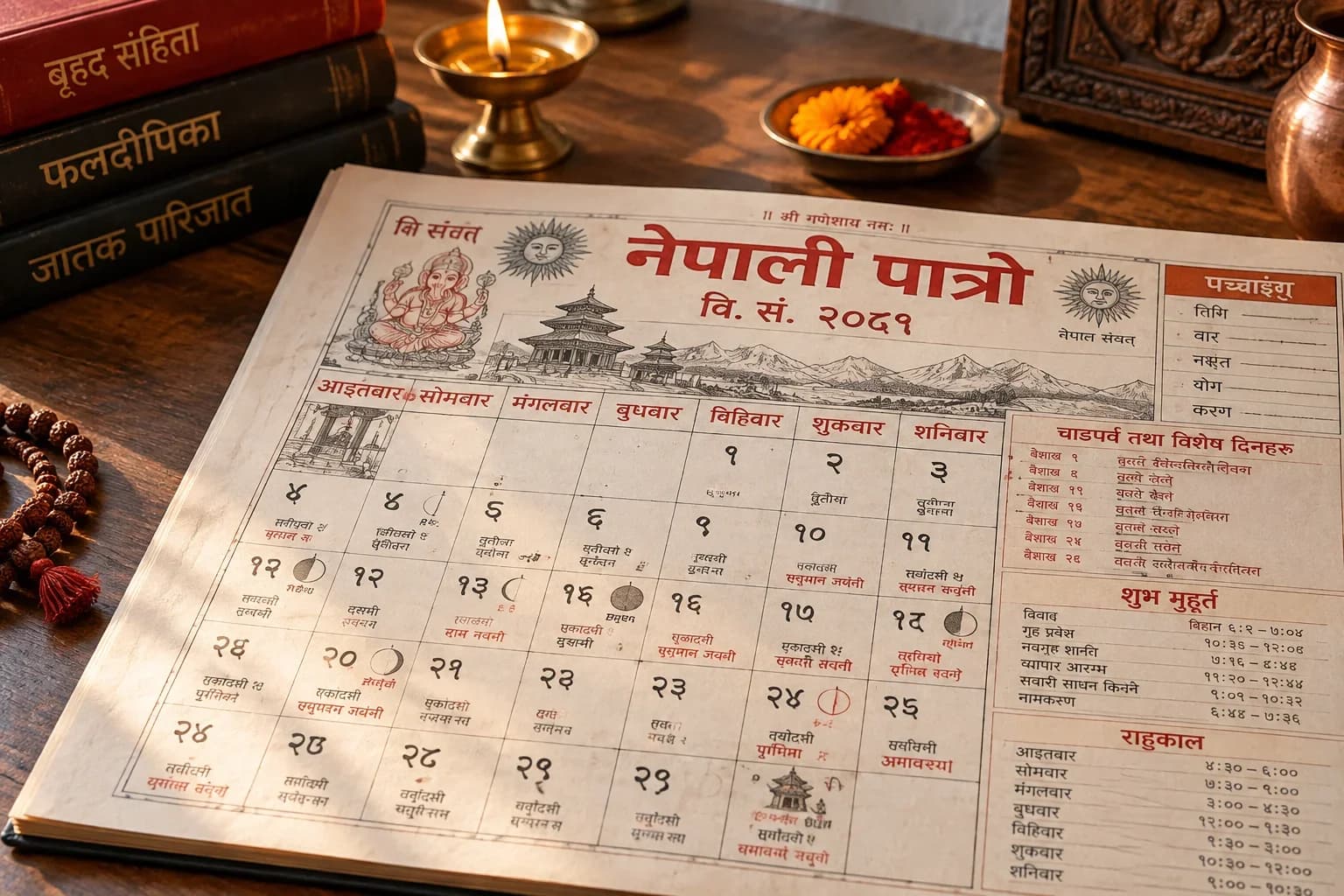
By the early centuries of the Common Era, horoscopic astrology was developing rapidly in India.
Texts associated with the Yavana tradition show the transmission and Sanskritisation of horoscopic techniques connected with the Hellenistic world. These ideas did not erase older Indian traditions. They became intertwined with Indian nakshatra systems, calendrical knowledge, religious concepts and indigenous methods of interpretation.
One of the great figures of the classical tradition is Varāhamihira, who lived in the sixth century and was associated with the region around Ujjain.
His surviving works illustrate just how broad Jyotish had become.
The Bṛhat Jātaka deals with horoscopic astrology.
The Bṛhat Saṃhitā ranges far beyond individual horoscopes into omens, astronomy, weather, architecture, agriculture, ritual timing and many other subjects.
The Pañcasiddhāntikā preserves important astronomical material drawn from several traditions.
Other influential works in the later Jyotish tradition include the Sārāvalī, Phaladīpikā, and the textual tradition transmitted under the title Bṛhat Parāśara Horā Śāstra.
These works do not always agree.
That is another fact worth remembering.
There is no single book from which every rule of Indian astrology can be mechanically extracted. Different authors, lineages and regional schools preserve different techniques and give different weight to particular factors.
Jyotish is a tradition of interpretation, not a one-page formula.
What is a Janma Kundali?
For most people today, the best-known part of Jyotish is the Janma Kundali — जन्म कुण्डली, the natal horoscope.
In Nepal it may also simply be called the china — चिना or janma patrika.
A birth chart is a representation of the celestial configuration calculated for a particular date, time and place of birth.
Those three pieces of information matter because the horoscope is not based only on the day someone was born.
The time determines the rising sign or Lagna.
The place affects the local horizon.
The Moon may change nakshatra or rāshi.
A small difference in time can alter the Lagna degree and, in certain cases, divisional charts used in later analysis.
That is why a proper Jyotish reading begins with accurate birth information rather than with a newspaper-style zodiac sign.
The Indian zodiac: the twelve Rāshis
Jyotish uses twelve zodiacal divisions called Rāshis — राशियाँ.
They are:
- Mesha — Aries
- Vrishabha — Taurus
- Mithuna — Gemini
- Karka — Cancer
- Simha — Leo
- Kanya — Virgo
- Tula — Libra
- Vrishchika — Scorpio
- Dhanu — Sagittarius
- Makara — Capricorn
- Kumbha — Aquarius
- Meena — Pisces
Each rāshi occupies 30 degrees of the 360-degree zodiac.
But this is where Indian astrology begins to differ noticeably from the simplified zodiac system encountered in magazines and social media.
In Jyotish, knowing that someone is “Mesha” or “Karka” is not enough to read the chart.
We must ask:
Is that the Moon sign?
The Lagna?
The Sun sign?
Which graha rules it?
Where is its lord placed?
What aspects does it receive?
Which house does it occupy?
What is the condition of the relevant graha?
Which daśā is operating?
A rāshi is one component of a network.
It is not a complete personality description.
Nirayana: the sidereal framework
A large part of contemporary Indian Jyotish works with the nirayana, or sidereal, zodiac.
This means planetary positions are referred to a zodiac anchored to a fixed stellar reference rather than directly to the moving tropical equinox used in most modern Western astrology.
The difference between tropical and sidereal reference frames is expressed through an ayanāṃśa.
There are different ayanāṃśa conventions, which is one reason two Jyotish programs or practitioners may occasionally give slightly different degrees.
This is not merely a modern internet convention. India's official Rashtriya Panchang, prepared through the Positional Astronomy Centre, publishes nirayana positions and explicitly describes the use of ayanāṃśa in calculating rāshis and nakshatras.
For a beginner, the important point is simpler:
Indian Jyotish usually does not calculate the zodiac in exactly the same way as mainstream modern Western tropical astrology.
So copying a Western birth-chart placement into a Jyotish interpretation without checking the calculation can produce the wrong rāshi altogether.
The nine Grahas
Jyotish traditionally works with Navagraha — nine grahas:
- Surya — Sun
- Chandra — Moon
- Mangala — Mars
- Budha — Mercury
- Guru or Brihaspati — Jupiter
- Shukra — Venus
- Shani — Saturn
- Rahu
- Ketu
The Sanskrit term graha should not simply be translated as the modern astronomical word “planet.”
The Sun and Moon are included among the grahas even though modern astronomy does not classify them as planets.
Rahu and Ketu are even more interesting.
They are not physical planets at all.
Astronomically they correspond to the two nodes of the Moon's orbit: the points where the Moon's path crosses the ecliptic.
Rahu is associated with the ascending node and Ketu with the descending node.
Indian astronomical literature was well aware of this mathematical reality. Classical astronomical texts calculated the nodes, and Indian astronomers such as Aryabhata explained eclipses through the actual geometry of the Sun, Moon and Earth's shadow rather than requiring a physical demon to swallow the luminary. Varāhamihira likewise discussed the astronomical mechanism while retaining the traditional Rahu terminology.
This is a good example of how Jyotish often contains several layers at once:
mythological language, ritual symbolism, astronomical calculation and astrological interpretation.
They need not be confused with one another.
Graha does not simply mean “planet causes event”
A common misunderstanding imagines Indian astrology like this:
Saturn sends bad energy. Jupiter sends good energy. Therefore events happen.
Classical Jyotish is considerably more complicated.
A graha is interpreted through numerous relationships:
- the rāshi it occupies;
- the bhāva it occupies;
- the houses it rules;
- its dignity;
- conjunctions;
- aspects or dṛṣṭi;
- strength;
- relationship with other grahas;
- divisional placement;
- the operating daśā;
- and the question being investigated.
Even the familiar division into “benefic” and “malefic” grahas does not mean that one planet always produces good events and another always produces bad events.
A planet's functional role can change according to the Lagna and the houses it governs.
Context is everything.
This is why isolated statements such as “Saturn in the seventh house means late marriage” are poor examples of serious Jyotish.
A single placement is rarely the whole judgement.
Lagna: where the chart begins
The Lagna — लग्न, or Ascendant, is the zodiacal sign rising on the eastern horizon at the time and place of birth.
In Jyotish, it is fundamental.
While popular astrology often begins with the Sun sign, a traditional horoscope reading commonly begins with the Lagna and its lord.
The Lagna establishes the orientation of the twelve houses.
If Mesha is rising, Mesha becomes the first house in a common whole-sign style of reading. If Kanya is rising, Kanya becomes the first.
The Lagna therefore changes the functional meaning of the planets from one chart to another.
This is one reason birth time matters so much.
Two children born on the same day can share very similar planetary positions but have different Lagnas if born at sufficiently different times or locations.
The Indian government's astronomical Panchang even publishes tables showing when different lagnas begin for specified locations, demonstrating that Lagna is a calculated astronomical quantity tied to time and place.
The twelve Bhāvas
The horoscope is also interpreted through twelve Bhāvas — भाव, usually called houses in English.
At a basic level they correspond to different areas of life.
Traditional meanings commonly include:
First Bhāva
Body, self, constitution, identity and the beginning of life.
Second Bhāva
Family, speech, accumulated resources and food.
Third Bhāva
Courage, effort, skills, communication and siblings.
Fourth Bhāva
Home, mother, property, inner security and education.
Fifth Bhāva
Children, intelligence, learning, creativity and mantra or purva-punya themes in traditional interpretation.
Sixth Bhāva
Illness, debts, conflict, service and obstacles.
Seventh Bhāva
Marriage, partnership, agreements and dealings with others.
Eighth Bhāva
Longevity, vulnerability, inheritance, hidden matters and transformation.
Ninth Bhāva
Dharma, teachers, higher learning, pilgrimage, fortune and father in many traditions.
Tenth Bhāva
Work, action, public responsibility, status and vocation.
Eleventh Bhāva
Gains, fulfilment of aims, networks and elder siblings.
Twelfth Bhāva
Expenditure, loss, withdrawal, sleep, foreign residence, confinement and liberation-oriented themes.
These descriptions are only an entrance.
A house is never judged by its number alone. Its rāshi, lord, occupants, aspects, strength and relevant timing periods all have to be examined.
Nakshatra: an older layer of Indian sky knowledge
Before the twelve-sign zodiac became central to Indian horoscopy, the nakshatra system already held an important place in Indian time-reckoning.
The standard Jyotish system commonly uses 27 nakshatras, divisions along the Moon's path.
They are:
Ashwini, Bharani, Krittika, Rohini, Mrigashira, Ardra, Punarvasu, Pushya, Ashlesha, Magha, Purva Phalguni, Uttara Phalguni, Hasta, Chitra, Swati, Vishakha, Anuradha, Jyeshtha, Mula, Purva Ashadha, Uttara Ashadha, Shravana, Dhanishtha, Shatabhisha, Purva Bhadrapada, Uttara Bhadrapada and Revati.
When the zodiac is divided equally among 27 nakshatras, each occupies:
13°20′
Each nakshatra is further divided into four padas, each of:
3°20′
Some older traditions and texts also work with a set of 28 lunar mansions, including Abhijit, so the history should not be reduced to the claim that there has always been only one immutable 27-part list. Scholarship on lunar mansions shows that these stellar divisions have a very old connection with lunar time-reckoning.
In practical Jyotish, the Moon's birth nakshatra can be especially important.
It may be used in naming traditions, compatibility calculations, muhūrta and daśā systems.
This is one reason a person's Janma Nakshatra often has greater technical importance in Indian astrology than a casual reader might expect.
Why the Moon matters so much
The Moon occupies a special place in Jyotish.
Traditional interpretation connects Chandra with the mind, emotional responsiveness, perception, habit and everyday experience.
But its importance is not merely symbolic.
The Moon moves relatively quickly through the zodiac and therefore provides a fine measure of timing.
Its nakshatra at birth is used in one of Jyotish's most influential timing systems: the Vimshottari Daśā.
The Moon is also central to the tithi, the lunar calendar and many ritual observances.
This helps explain why, in Nepal and India, people may know their Chandra rāshi even when they know nothing about the Western-style Sun sign associated with their birthday.
Daśā: astrology as time, not just personality
A birth chart is static.
A life is not.
Indian astrology therefore developed systems called Daśās — दशा, which divide life into planetary periods.
There are multiple daśā systems in classical literature. The textual tradition of the Bṛhat Parāśara Horā Śāstra, for example, describes a number of them.
The best-known today is Vimshottari Daśā.
Its complete theoretical cycle covers 120 years distributed among nine grahas in the following sequence:
- Ketu — 7 years
- Venus — 20 years
- Sun — 6 years
- Moon — 10 years
- Mars — 7 years
- Rahu — 18 years
- Jupiter — 16 years
- Saturn — 19 years
- Mercury — 17 years
The birth nakshatra of the Moon is normally used to determine where in this sequence a person's life begins.
Each major period, or Mahādaśā, contains smaller sub-periods called Antardaśās, and further subdivisions can also be calculated.
The important concept is not that a planet suddenly “becomes active” like a switch.
Rather, Jyotish uses daśā as a framework for asking:
Which parts of the natal chart are especially relevant during this period of life?
The answer still depends on the condition and role of that graha in the individual chart.
A Jupiter daśā cannot responsibly be called universally fortunate.
A Saturn daśā cannot responsibly be called universally disastrous.
The chart decides the context.
Gochar: the planets continue moving
Alongside daśā, astrologers study Gochar — गोचर, planetary transits.
A natal horoscope records a moment of birth, but the planets continue their apparent movement through the zodiac.
A transit compares the current planetary configuration with natal positions.
Saturn's transit, Jupiter's transit, the movement of Rahu and Ketu and the Moon's much faster passage can all be considered.
Once again, a transit is not normally read in isolation.
A major transit may become more relevant when it echoes:
- the natal chart;
- the running daśā;
- an important house;
- its lord;
- or another active astrological factor.
This layered approach is one of the major differences between serious Jyotish and daily horoscope columns.
Vargas and the Navamsha
Jyotish also uses Varga, or divisional charts.
A rāshi can be mathematically subdivided, and the resulting divisions are reorganised into specialised charts.
The most famous is the Navamsha, commonly called the D9 because each 30-degree rāshi is divided into nine parts.
Navamsha receives considerable attention in classical horoscopy and is especially important in judging the underlying condition of planets and, in many traditions, questions relating to marriage and dharma.
Other divisional charts are used for specialised analysis.
Their use is also a reminder that accurate birth time becomes increasingly important as a chart is subdivided more finely.
The deeper we go into Jyotish, the less sensible it becomes to make absolute statements from one visible placement.
Pañcāṅga: Jyotish in everyday Nepali life
If the birth chart represents one side of Jyotish, the Pañcāṅga — पञ्चाङ्ग represents another.
The name literally refers to five limbs.
Traditionally these are:
- Tithi — lunar day
- Vāra — weekday
- Nakshatra — lunar mansion
- Yoga
- Karaṇa
Classical astronomical literature explicitly lists these five constituents of the calendar.
In Nepal, the living importance of this tradition can still be seen very clearly.
The Nepal Panchanga Nirnayak Bikas Samiti, under the Ministry of Culture, Tourism and Civil Aviation, oversees matters connected with authorised Panchanga publication. Its notices require calendrical calculations involving planetary rise and setting, festivals, marriage and bratabandha muhūrtas, eclipses and related matters.
This is not an archaeological survival kept in a museum.
It is part of contemporary Nepali calendrical life.
Dashain, Tihar, Bhai Tika and many other observances are organised through calculations involving tithi and other calendrical factors. The committee publishes specific auspicious timings for occasions such as Vijayadashami and Bhai Tika.
There is a particularly useful lesson in its Bhai Tika guidance.
The committee explicitly notes that a sait calculated for Nepal should not simply be copied by people living in another country; timing must be adjusted to the local place and time.
That small statement reveals something fundamental about genuine Jyotish calculation:
place matters.
The sky is not read as though every person on Earth is standing in Kathmandu.
Muhūrta: choosing a time
Muhūrta — मुहूर्त is the branch concerned with choosing an appropriate time for an undertaking.
In the Nepalese context, this may appear in the familiar word sait — साइत.
Traditional applications include such events as:
- marriage;
- bratabandha;
- house entry;
- religious ceremonies;
- travel;
- initiation;
- beginning particular undertakings.
The principle differs from natal astrology.
A natal chart asks:
What was the celestial configuration when this person was born?
Muhūrta asks:
Among the available times, which configuration is traditionally considered more suitable for beginning this action?
Classical Jyotish literature contains detailed rules for such electional timing. Varāhamihira's Bṛhat Saṃhitā, for example, contains extensive material relating to auspicious timing and marriage considerations.
Nepal's present-day Panchanga system shows that this branch remains culturally active rather than merely historical.
Praśna: when there is no birth chart
Another traditional branch is Praśna — प्रश्न, literally “question.”
Here the astrologer constructs or interprets a chart connected with the time a serious question is asked rather than beginning from the person's natal horoscope.
Different Indian regional traditions developed highly elaborate approaches to Praśna.
It should therefore not be confused with randomly drawing a horoscope for every passing thought.
Traditionally, the seriousness of the question, the time and the interpretive rules of the relevant school matter.
We will treat Praśna separately later in this series because it deserves more than a few paragraphs.
How a Jyotish chart is actually read
This is where many modern astrology pages become misleading.
They break a chart into tiny pieces:
“Moon in Taurus means this.”
“Mars in the seventh means that.”
“Rahu in the tenth means something else.”
Then they join the sentences together and call it a reading.
Traditional Jyotish requires synthesis.
There is no single universal order used by every lineage, but a serious natal analysis normally has to consider questions such as:
What is the Lagna?
What is the condition of its lord?
Where is the Moon?
What rāshi and nakshatra does it occupy?
What are the relevant house and its lord doing?
If marriage is being considered, for example, simply seeing the seventh house is not enough.
One may need to examine the seventh lord, planets occupying or aspecting the seventh, relevant kārakas, the condition of Venus and/or Jupiter according to the method being used, Navamsha, daśā and current timing factors.
If career is being examined, attention shifts toward the tenth house, its lord, relevant grahas, strength, daśā and associated divisional considerations.
For any judgement, the astrologer may consider:
- rulership;
- occupation;
- aspects;
- conjunctions;
- planetary dignity;
- strength;
- benefic and difficult influences;
- yogas;
- divisional charts;
- daśā;
- and transits.
Only then does interpretation begin.
This is why one should be cautious whenever an astrologer makes a frightening conclusion from a single placement.
Jyotish itself is more nuanced than that.
What about Yogas?
The word Yoga appears frequently in Jyotish, but here it does not necessarily mean physical or meditative yoga.
In natal astrology, a yoga is a particular planetary relationship or configuration to which the tradition assigns a result or tendency.
Classical texts contain large numbers of yogas.
Some have become famous under names such as Rāja Yoga or Dhana Yoga.
But identifying a yoga on paper is not the same as establishing that its promised result must occur exactly as a verse describes.
The strength of the participating planets, competing indications elsewhere in the horoscope and the timing of the relevant planets all matter.
A chart may contain both supportive and difficult combinations.
Human lives do too.
Is Jyotish about fate?
This question cannot be avoided.
Traditional Indian astrology developed within cultures that also discussed karma, dharma, daiva and purushartha.
Astrological texts often connect the birth chart with the unfolding effects of karma. Scholarly work on Indian astrology has also noted this close conceptual relationship between karma and horoscope interpretation.
But turning that into “everything is predetermined” would be too simple.
Indian philosophical traditions have spent centuries debating the relationship between destiny, previous action, present action, circumstance and human effort.
Jyotish itself does not require a useful reading to become a declaration of helplessness.
A chart can instead be approached as a traditional map of conditions, tendencies and timing.
It may say, within the logic of the tradition:
This period deserves greater care.
This area of life is strongly emphasised.
This pattern may repeat.
This strength can be developed.
This is a more responsible use of astrology than treating a horoscope as a final court verdict.
Jyotish is not the same as certainty
Astrology has always attracted certainty because certainty is attractive.
People want to know:
When will I marry?
Will I become rich?
Will I go abroad?
Will this relationship survive?
Will I get this job?
When will my difficulties finish?
A horoscope can easily become a place where hope and fear are exploited.
That is where discipline is needed.
A careful Jyotish practice should distinguish between:
calculation and interpretation.
The position of a planet at a given moment can be calculated.
Its traditional astrological meaning is interpreted.
Those are not the same kind of claim.
Similarly, Jyotish has a substantial historical relationship with Indian astronomy, but the predictive claims of astrology should not simply be presented as though modern experimental science has established them.
One can respect a tradition without making claims for it that evidence does not support.
For this reason, throughout this series I will try to separate:
- what a classical text actually says;
- what later Jyotish traditions commonly teach;
- what is a regional practice;
- what is symbolic interpretation;
- what is astronomical calculation;
- and what is a matter of belief.
That distinction does not weaken the subject.
It makes the study more honest.
The Jyotish practised in Nepal
Nepal does not stand outside the wider Indian Jyotish tradition.
For centuries, Sanskrit learning, Hindu ritual traditions, calendrical astronomy and astrological practice have moved throughout the Himalayan region and the plains to the south.
The technical vocabulary used by a Nepali astrologer—graha, rāshi, nakshatra, tithi, lagna, daśā, muhūrta, kundali—belongs to this larger Sanskritic world.
Yet the way Jyotish is lived in Nepal has its own local texture.
We consult the Nepali patro.
We organise life through Bikram Sambat dates alongside lunar tithis.
Our major festivals depend upon traditional calendrical calculations.
Families may preserve a handwritten china for decades.
Marriage dates are discussed as sait.
The timing of Dashain tika can become a national conversation.
Bhai Tika has an officially announced auspicious time.
Birth, naming, initiation, marriage and death rituals can all bring calendrical and Jyotish considerations into family life.
The Nepal Panchanga authority's current work even specifies systems to be used in preparing national Panchangas and continues to conduct training connected with Jyotish and karmakāṇḍa.
So when we study Jyotish from Nepal, we do not need to imitate the language of Western “Vedic astrology” websites.
We can begin from the tradition that is already around us.
A note on “Vedic Astrology”
The English expression Vedic astrology is now extremely common.
I will occasionally use it when it helps readers understand what subject we are discussing, but Jyotish or Jyotiṣa is the more historically useful term.
Why be careful?
Because the astrology practised today contains layers from many periods.
The early Vedāṅga Jyotisha is not a manual of modern birth-chart interpretation.
The twelve-sign horoscopic system developed later.
Indian astrologers then created an enormous Sanskrit astrological literature around rāshis, bhāvas, grahas, nakshatras, yogas, vargas, daśās and other techniques.
Calling the whole accumulated tradition “Vedic” can therefore create the false impression that every rule in a medieval or later horoscope text can be found directly in the Vedas.
It cannot.
The real history is more interesting.
Jyotish evolved.
It absorbed.
It argued.
It calculated.
It preserved older ideas while creating new systems.
And different parts of that history are still visible in the practice today.
Where should a beginner begin?
Not with predictions.
Begin with the architecture.
Learn what the following words actually mean:
Graha
The nine astrological agents used in Jyotish.
Rāshi
One of the twelve zodiacal divisions.
Lagna
The rising sign and degree at the time and place of birth.
Bhāva
One of the twelve areas or houses of the horoscope.
Nakshatra
A lunar mansion used in timing and interpretation.
Daśā
A planetary period system.
Gochar
Planetary transit.
Varga
A divisional chart.
Pañcāṅga
The traditional five-limbed calendar.
Muhūrta
Election of an appropriate time.
Praśna
Astrology based around a specific question.
Once these are clear, the horoscope stops looking like a mysterious square or diamond filled with numbers.
It becomes a language.
And, like any language, it should be learned through grammar before poetry.
What we will study next
This introduction has deliberately covered a large landscape without pretending to finish the subject.
The next step will be much more practical:
How to Read a Janma Kundali: The Basic Structure of a Jyotish Birth Chart
There we will take an actual North Indian-style horoscope and learn how to identify:
- the Lagna;
- the twelve houses;
- the twelve rāshis;
- the nine grahas;
- house lords;
- planetary placements;
- basic aspects;
- the Moon's nakshatra;
- and the first sequence an astrologer follows before attempting interpretation.
After that, we can study each part properly—Lagna, grahas, bhāvas, rāshis, nakshatras, yogas, Vimshottari Daśā, Navamsha, Gochar, Panchanga, Muhūrta and Praśna—without rushing them into one article.
There is enough material here for years of study.
That is precisely why Jyotish should not be reduced to a daily prediction beside a zodiac symbol.
A final thought
For me, the most interesting way to approach Jyotish is neither blind belief nor casual dismissal.
It is to ask good questions.
What did the old texts actually teach?
Which ideas belong to astronomy and calendar-making?
Which belong to horoscopic interpretation?
Which techniques appeared early, and which developed later?
How did India absorb outside astronomical and astrological ideas without losing its own traditions?
Why does the Moon matter so much?
Why does a Nepali patro still shape the dates of festivals and rituals today?
What can a birth chart reasonably be asked to tell us—and where should interpretation stop?
These questions make Jyotish more interesting, not less.
The night sky has been observed from this part of the world for a very long time. Our ancestors watched the seasons, Moon, stars and wandering grahas because time mattered: for ritual, agriculture, travel, festivals, community and the ordering of life.
Out of that long attention to the sky grew many systems.
Jyotish is one of them.
To understand it, we should neither strip away its tradition nor decorate it with claims it never needed.
We should learn to read it carefully.
Classical texts and research foundations for this series
The study in this article draws principally upon the historical and technical traditions represented by:
- Vedāṅga Jyotiṣa
- Bṛhat Jātaka — Varāhamihira
- Bṛhat Saṃhitā — Varāhamihira
- Pañcasiddhāntikā — Varāhamihira
- Sārāvalī — Kalyāṇavarma
- Phaladīpikā — Mantreśvara
- Bṛhat Parāśara Horā Śāstra tradition
- classical Indian astronomical literature preserved in modern source collections
- publications of the Nepal Panchanga Nirnayak Bikas Samiti
- astronomical and calendrical material of India's Positional Astronomy Centre / Rashtriya Panchang
These sources do not all belong to the same historical period or school. Where they differ, later articles in this series will identify those differences rather than forcing them into a single interpretation.