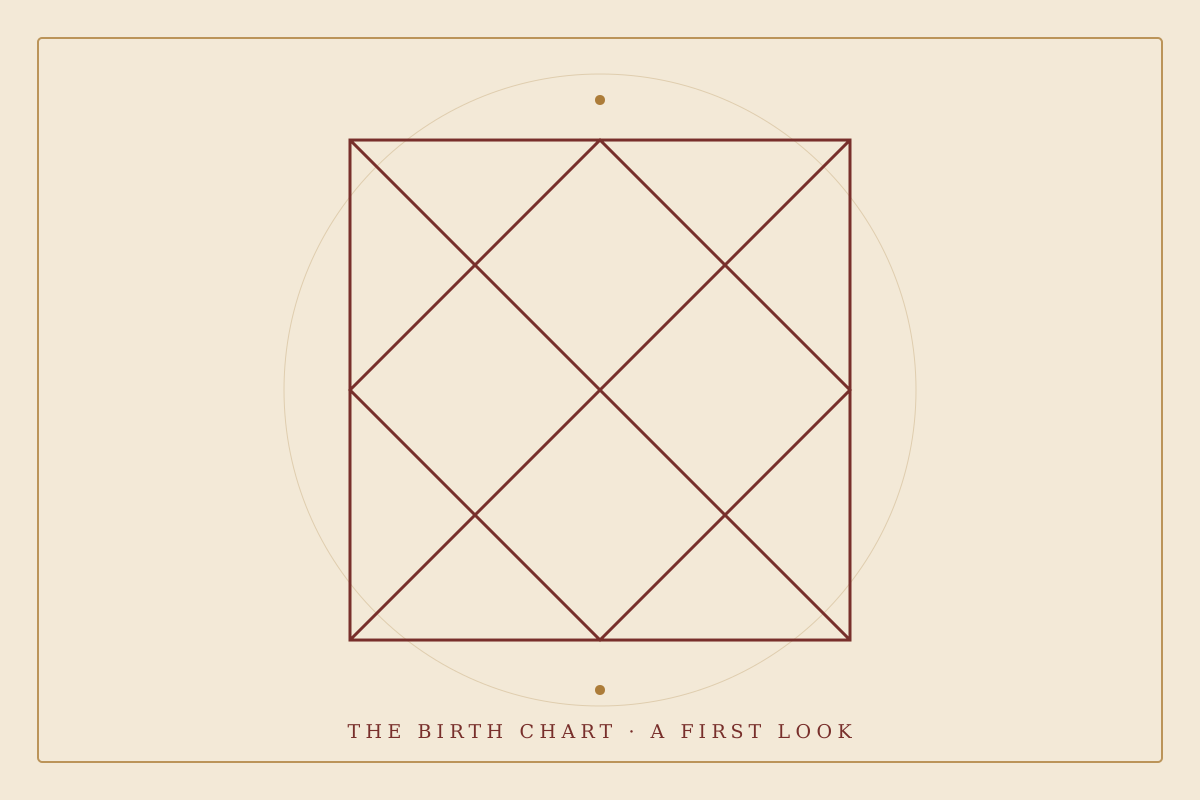
A Janma Kundali is often described as a “birth chart.”
That translation is useful, but it does not tell us very much.
What is being charted?
Why does the chart require the place of birth as well as the date?
Why can five or ten minutes sometimes matter?
Why does a traditional Nepali china contain pages of calculations when the familiar diamond-shaped diagram occupies only a small part of it?
And which parts of the document are actually calculated, as opposed to interpreted?
These questions are worth answering before we begin reading individual houses or planets.
A Janma Kundali — जन्म कुण्डली is a horoscope constructed for the time and place of a person's birth. It organises celestial positions into the framework used by Indian Jyotish: the zodiacal signs or Rashis, the twelve Bhavas, the Lagna, the nine Grahas, and, depending on how detailed the horoscope is, further information such as Nakshatra, Pada, Panchanga factors, divisional charts and Dashas.
In practical terms, it begins with a moment:
Where was the person born, and what was the sky doing at that time?
Jyotish then takes that calculated celestial arrangement and interprets it according to its own traditional principles.
That distinction—between calculation and interpretation—is fundamental.
Janma, Kundali, Janma Patrika and China
Several names are used for a birth horoscope across India and Nepal.
Janma — जन्म
Janma means birth.
So whenever we encounter terms such as:
- Janma Kundali
- Janma Rashi
- Janma Nakshatra
- Janma Lagna
the word is referring us back to the circumstances or configuration associated with birth.
Kundali — कुण्डली
In modern Hindi, Nepali and related usage, Kundali commonly refers to the horoscope or astrological chart. Dictionaries also record meanings connected with a circle, coil or ring, alongside its established use for a horoscope.
In everyday speech, particularly in India, one may also hear:
Kundli
Janam Kundli
Janam Patri
Janma Patrika
Jataka
These terms overlap in common usage, although particular regions and textual traditions may prefer one over another.
Janma Patrika — जन्मपत्रिका
Patrika carries the sense of a written record or document.
A Janma Patrika may therefore refer not merely to the visible Rashi chart but to the broader horoscope document containing calculations and related information.
China — चिना
In Nepal, one of the most familiar everyday words is simply:
चिना — china
A Nepali family may say:
“चिना बनाएको छ?”
or:
“चिना हेराउनु पर्छ।”
rather than repeatedly using the formal expression Janma Kundali.
Nepali Jyotish services themselves commonly use china and Janma Kundali as equivalent everyday terms.
But a traditional china may be more than the single diagram people now see on mobile astrology applications.
It can be a complete birth record prepared according to the methods used by the astrologer who calculated it.
That distinction will become important shortly.
A Kundali begins with astronomy before it becomes astrology
This is one of the most useful facts a beginner can learn.
Before anyone says:
“Jupiter means this,”
or:
“Saturn will give that result,”
someone first has to determine where Jupiter and Saturn were located.
That part is calculation.
The Sun, Moon and planets have astronomical positions.
The Moon has a measurable longitude.
The lunar nodes can be calculated.
The eastern horizon for a particular place and moment can be calculated.
From these positions, the Lagna, Rashi placements, Nakshatra and other chart factors can be determined according to the astronomical and calendrical system being used.
Only after this does Jyotish attach traditional interpretive meaning to the resulting configuration.
So we can separate the process into two broad stages:
Stage One — Calculation
Questions such as:
- Where was the Moon?
- What zodiacal longitude did Saturn have?
- Which sign was rising?
- What Nakshatra contained the Moon?
- What was the Tithi?
- What was the Lagna degree?
These can be calculated.
Stage Two — Interpretation
Questions such as:
- What does that Moon signify in this horoscope?
- What does Saturn's lordship mean?
- How should the seventh Bhava be judged?
- What might the running Dasha indicate?
- How should several contradictory indications be weighed?
These belong to astrological interpretation.
A serious Jyotish reading requires both, but they are not the same kind of information.
The three essential birth details
To construct a normal natal horoscope, we begin with three pieces of information:
3. Place of birth
Modern Kundali calculation tools, including widely used Indian Panchanga services, ask for this same combination of birth date, time and location before calculating the horoscope.
Each input has a different job.
Let us examine them separately.
1. Date of birth: more important than merely knowing your birthday
The date tells us which astronomical day must be calculated.
That sounds straightforward until we work with older records.
For someone born recently in Kathmandu, an official record may clearly say:
11 May 1998
and there is little ambiguity.
But a family record may instead give the birth in Bikram Sambat.
For example:
२०५५ साल वैशाख...
Now the date must be converted correctly before software expecting a Gregorian date can use it.
A one-day conversion error can matter.
The Moon moves through roughly one Nakshatra per day, so an incorrect date can place the Moon substantially away from its true position.
The Tithi may change.
The Nakshatra may change.
The planetary positions—particularly the faster-moving Moon—will no longer represent the actual birth moment.
This is why an old handwritten china should not be converted casually by guessing an English date from memory.
Bikram Sambat needs special attention in Nepal
This issue deserves emphasis in a Nepal-focused guide.
Many older Nepali documents record dates in Bikram Sambat (B.S.).
Modern Kundali software aimed at Nepali users sometimes therefore accepts both B.S. and A.D. dates, precisely because users may possess their original birth record in the Nepali calendar.
If the original date is in B.S., we should preserve that original information.
Then, if conversion is necessary, it should be done carefully.
Never “correct” the original birth date in a family china simply because a modern application gives a different output until the following have been checked:
- B.S.–A.D. conversion;
- birth time;
- location;
- time zone;
- calculation method;
- ayanamsha;
- node setting;
- and the chart format being compared.
Two charts that appear different do not always prove that one astrologer made a mistake.
Sometimes they were calculated using different conventions.
2. Birth time: why a few minutes can matter
Birth time is especially important because the sky is continuously changing relative to the local horizon.
The Earth is rotating.
As it rotates, different portions of the zodiac rise in the east.
The zodiacal point rising on that eastern horizon is the Lagna or Ascendant.
This means Lagna is not determined simply by the date.
It depends strongly on:
time
and
location.
The Lagna normally remains within one Rashi for roughly two hours on average, but “two hours” should never be treated as a fixed rule. Signs rise at different rates depending on latitude, and the exact timing changes with location and season. Official Indian Panchanga material therefore publishes Lagna tables tied to place and provides calculations rather than assuming one universal two-hour block.
More importantly, even when the Lagna Rashi does not change, its degree continues moving.
So these two birth times:
6:03 AM
and
6:28 AM
may produce the same Lagna Rashi but different Lagna degrees.
At a basic D1 level, the charts might appear almost identical.
At a finer level, they may not be.
Why Lagna degree matters
Suppose someone's Lagna is:
Karka 2°
and another person's is:
Karka 27°.
Both are Karka Lagna.
A beginner looking only at the sign might think the Ascendants are essentially identical.
But their precise degrees are far apart.
That becomes important for several reasons.
It can affect:
- finer house calculations in systems that use cusps;
- divisional-chart placements;
- certain planetary relationships;
- strength calculations;
- and any technique sensitive to exact longitude.
Near a Rashi boundary, even a relatively small time error may change the Lagna from one sign to another.
If that happens, the effect is much larger.
Why?
Because changing Lagna changes the arrangement of the houses.
And once the houses change, planetary lordships change with them.
A planet that rules the fifth house in one Lagna may rule completely different houses in another.
This is why a wrong Lagna cannot always be treated as a minor error.
It can change the architecture of the reading.
“I was born sometime in the morning” is not an exact birth time
Many people do not know their precise birth time.
They may have been told:
around sunrise
about six
after breakfast
late at night
or:
between 2 and 3 PM
That information is still useful.
But it should not be silently transformed into false precision.
If someone says:
“My mother thinks I was born around 7 AM,”
we should not enter:
07:00:00
into software and then present every divisional placement as though the original time had been recorded to the second.
The chart may be usable for some purposes, but uncertainty should remain visible.
Later in this series we can examine birth-time rectification, where astrologers attempt to narrow an uncertain time using life events and other techniques.
For now the principle is straightforward:
The accuracy of the interpretation cannot be greater than the accuracy of the data on which the chart depends.
What actually counts as “birth time”?
This question is more complicated than it first appears.
Modern hospitals may record a clock time, usually close to the completion of birth.
Traditional astrologers and texts have not always been completely uniform about defining the precise instant relevant to birth, and different practitioners may discuss first breath, complete emergence of the body or other moments.
For a contemporary chart, the most practical source is usually the officially recorded birth time where one exists.
If family memory and hospital documentation disagree significantly, that discrepancy should be noted rather than quietly choosing whichever time produces the more attractive horoscope.
Again, good chart work starts by respecting the data.
3. Birthplace: why Kathmandu and Pokhara are not interchangeable
A common beginner assumption is:
“The planets are in the same sky, so why does my birthplace matter?”
Because the Kundali is not calculated from an imaginary point outside Earth.
It is calculated relative to a specific observer's location.
Two geographical quantities matter especially:
Latitude
How far north or south the birthplace is.
Longitude
How far east or west it lies.
These coordinates help determine the local relationship between the zodiac and the horizon.
That is essential for calculating Lagna.
Modern Kundali programs therefore ask for the birth city or exact coordinates. More advanced forms explicitly use latitude, longitude and time-zone information.
The planetary longitudes themselves will be nearly the same for two people born at the same instant in Kathmandu and Delhi.
But their local horizons are not identical.
Therefore their Lagnas—and consequently their house structures—can differ.
This is why birthplace matters.
Time zone: the hidden fourth piece of information
People often say that a horoscope needs three details:
date, time and place.
That is correct for practical purposes.
But computationally, the place and civil time must also be connected to the correct time zone.
Nepal provides a particularly memorable example.
Nepal Standard Time today is:
UTC +5:45
That quarter-hour difference is not something software should casually round to Indian Standard Time.
India uses:
UTC +5:30
So Kathmandu and Delhi clocks differ by fifteen minutes under their present standard times.
If a calculator incorrectly treats a Nepali birth time as Indian Standard Time, it shifts the astronomical instant by fifteen minutes.
For slow-moving planets this may barely alter the visible sign position.
For the Lagna, however, fifteen minutes is not something we should dismiss.
And in cases close to a boundary, even a relatively small error can matter.
This is one reason good astrology software asks for place rather than asking users to manually assume a generic national time.
Historical time zones can become even more complicated
For recent Nepali births, modern time-zone handling is generally straightforward.
Older historical charts can require more care.
Countries change standard times.
Some regions have used daylight saving.
Political boundaries change.
Historical local-time practices differ.
Modern astronomical software may therefore maintain historical time-zone records so that the civil time written on an old document can be converted to the correct astronomical instant.
For a beginner, there is no need to perform all of this manually.
The lesson is simply:
“7:00 AM” has meaning only when we know where and under which civil-time system that clock reading occurred.
From clock time to astronomical time
So how does a modern program turn birth information into a Kundali?
We do not need advanced mathematics yet, but understanding the sequence prevents the chart from seeming magical.
Conceptually, the calculation proceeds through several stages.
Step 1 — Establish the actual moment
The birth date and local clock time are interpreted according to the time zone of the birthplace.
This allows the software or astrologer to establish a common astronomical time reference.
Older astrologers did this work through traditional astronomical tables and calculations.
Modern software performs it almost instantly.
But the underlying requirement has not disappeared:
we must know which moment is being calculated.
Step 2 — Calculate the positions of the celestial bodies
The astronomical positions of the relevant bodies are determined for that instant.
In mainstream Jyotish this usually includes:
- Sun;
- Moon;
- Mars;
- Mercury;
- Jupiter;
- Venus;
- Saturn;
- Rahu;
- Ketu.
Rahu and Ketu require a special explanation.
They are not physical planets.
They are the two lunar nodes—the points where the Moon's orbital path intersects the ecliptic.
Because the two nodes are opposite each other, if Rahu is at one zodiacal longitude, Ketu lies approximately 180° away.
Modern programs may offer a choice between mean and true nodes, which is one reason Rahu and Ketu can occasionally show slightly different degrees between two otherwise similar charts. India's official Rashtriya Panchang itself distinguishes mean and true lunar-node calculations in its astronomical tables.
We will examine Rahu and Ketu properly in the Graha section.
Step 3 — Establish the zodiacal reference
Most contemporary Indian Jyotish uses a Nirayana, or sidereal, zodiac.
The astronomical calculation therefore has to establish where the Grahas fall within that zodiac.
This introduces an important term:
Ayanamsha — अयनांश
Very simply, ayanamsha represents the angular difference used when converting between the tropical and sidereal zodiacal frameworks.
There is more than one ayanamsha convention.
One of the most widely used in contemporary Indian astrology is Lahiri/Chitrapaksha ayanamsha.
India's official Rashtriya Panchang publishes a specified ayanamsha and provides Nirayana planetary positions as part of its astronomical material.
This matters because two pieces of astrology software can use:
- the same birth date;
- the same birth time;
- the same place;
and still produce slightly different planetary degrees if their ayanamsha settings differ.
Usually these differences are small.
Near a sign or Nakshatra boundary, however, a small difference can become visible.
We will study ayanamsha properly later.
For now, simply check which system your chart uses.
Step 4 — Calculate the Lagna
Once the time and location are known, the zodiacal point rising on the eastern horizon can be determined.
That gives us the Lagna degree.
Suppose the calculation gives:
Kanya 17°42′
That means Kanya is rising and the Lagna has reached 17 degrees and 42 minutes within that Rashi.
In a standard whole-sign Rashi chart used by many Jyotish practitioners:
Kanya becomes the first house.
Then:
Tula becomes the second.
Vrishchika the third.
Dhanu the fourth.
And the sequence continues around the zodiac.
Suddenly one astronomical result—the rising Rashi—has organised the entire horoscope.
That is why we keep returning to Lagna.
Step 5 — Place the Grahas in their Rashis
Now the planetary longitudes are translated into the twelve zodiacal signs.
For example, purely as an illustration:
Sun — Mithuna 14°
Moon — Kanya 26°
Mars — Simha 8°
Jupiter — Karka 19°
and so on.
At this stage we know the Rashi position of each Graha.
Because the Lagna has already established the houses, we can also determine the Bhava position in the chart system being used.
That is how we arrive at statements such as:
“Jupiter is in Karka in the eleventh Bhava.”
Notice how much information is contained in that one sentence.
Jupiter = Graha.
Karka = Rashi.
Eleventh = Bhava.
Later we will learn to keep those layers separate before combining them.
Step 6 — Determine Nakshatra and Pada
The zodiac used in Jyotish is also divided into 27 Nakshatras.
Each standard Nakshatra spans:
13°20′
Each is further divided into four Padas of:
3°20′ each.
Once a planet's exact longitude is known, its Nakshatra and Pada can therefore be calculated.
For the Moon this becomes especially important.
Its position gives us the:
Janma Nakshatra
or birth Nakshatra.
This is used in numerous traditional calculations and practices, including the starting balance of the widely used Vimshottari Dasha system.
So a difference of degree is not a meaningless technical detail.
It tells us exactly where within the Nakshatra structure the Moon was situated.
Step 7 — Calculate the Panchanga factors
A detailed horoscope may also record the five limbs of the traditional Panchanga:
Vara
Weekday.
Tithi
Lunar day, based on the angular relationship between Sun and Moon.
Nakshatra
Usually the Nakshatra occupied by the Moon.
Yoga
A calendrical factor derived from the longitudes of Sun and Moon.
Karana
Half of a Tithi.
These are not arbitrary labels added by an astrologer after looking at the chart.
They are calculated from astronomical relationships according to the Panchanga system.
This remains part of a living calendrical tradition in Nepal. The Nepal Panchanga Nirnayak Bikas Samiti—the government body responsible for Panchanga-related decisions and publication—continues to require calculations dealing with planetary positions, rise and setting, festivals, eclipses and Muhūrta when approving Panchangas.
That matters because it reminds us that Jyotish in Nepal does not live only inside personal birth horoscopes.
It is also woven into calendrical practice.
Step 8 — Derive the divisional charts
A full Jyotish horoscope may then show charts such as:
D1 — Rashi
D9 — Navamsha
and sometimes:
D2, D3, D4, D7, D10, D12 and many others.
These do not require another birth moment.
They are mathematically derived from the original planetary longitudes.
That point is important.
A Navamsha is not a second sky.
It is a division of the natal zodiacal positions according to a particular Jyotish scheme.
This is also why exact degrees become increasingly important when studying Vargas.
A slight time difference may leave the visible D1 Rashi placements unchanged while altering a sensitive divisional placement, particularly for Lagna.
For beginners, however, we will not start there.
The D1 Rashi chart remains our foundation.
Step 9 — Establish the Dasha starting point
Many complete Kundalis include a Vimshottari Dasha table.
Vimshottari divides a theoretical cycle of 120 years among nine Grahas.
But everyone does not begin life at the beginning of the same Mahadasha.
The starting Mahadasha and the remaining balance at birth are calculated from the Moon's position within its Janma Nakshatra.
Therefore, once again:
Moon degree matters.
Two people with the Moon in the same Nakshatra but at different points within it may begin life with different amounts of the corresponding Dasha remaining.
We will calculate and interpret this later.
At this stage, just recognise why your china may contain a long table of planetary periods and dates.
Those dates have been derived from the natal calculation rather than written randomly.
What might a complete Nepali China contain?
There is no single handwritten format used by every Nepali Jyotishi.
A china prepared in one family or tradition may differ greatly from another.
Still, a detailed birth record may contain some combination of the following:
Personal birth information
- name;
- date of birth;
- birth time;
- birthplace;
- Bikram Sambat date;
- weekday.
Panchanga details
- Tithi;
- Vara;
- Nakshatra;
- Yoga;
- Karana.
Birth-specific Jyotish information
- Lagna;
- Chandra Rashi;
- Janma Nakshatra;
- Nakshatra Pada;
- planetary positions.
Charts
- Rashi Kundali;
- Navamsha;
- possibly additional Vargas.
Dasha information
- Mahadasha sequence;
- balance at birth;
- Antardashas or further subdivisions depending on the document.
Traditional naming information
In some traditions, the Janma Nakshatra and Pada are connected with recommended initial sounds or syllables used when choosing a ritual or birth name.
Other calculations
Depending on the astrologer, lineage, period and purpose, an older china may include calculations or annotations that a modern basic Kundali application does not show at all.
Modern Nepali chart generators illustrate how broad such a dataset can become: some display both A.D. and B.S. dates, Panchanga factors, Rashi and Navamsha charts, Nakshatra/Pada and Vimshottari Dasha together.
That is why we should avoid thinking of the diamond-shaped Rashi chart as the entire China.
It may be only its most immediately recognisable part.
A handwritten China and a modern computer Kundali may look completely different
Suppose your grandfather's china was prepared by hand.
Next to it, you generate a chart on a modern website.
The old document may have:
- Devanagari notation;
- traditional abbreviations;
- calculations written in rows;
- B.S. dates;
- Ghadi/Pala-style time notation in some older practices;
- two or more small charts;
- Dasha tables written manually.
The modern version might display:
- colourful boxes;
- English abbreviations;
- decimal coordinates;
- downloadable PDF tables;
- automatically generated interpretations.
Visually, they may seem unrelated.
But the first question should not be:
“Which one looks more professional?”
It should be:
“Do the underlying astronomical positions agree?”
Compare:
- Lagna Rashi and degree;
- Moon Rashi and degree;
- Sun;
- other Grahas;
- Nakshatra;
- Rahu/Ketu convention;
- ayanamsha;
- birth data.
Presentation is secondary.
Calculation comes first.
Why two Kundalis for the same person sometimes disagree
This deserves attention because beginners encounter it quickly.
You enter your birth details into two websites.
One says:
Moon 29°59′ in one Rashi.
Another says:
Moon 0°01′ in the next.
Or perhaps the Lagna changes.
Which is correct?
Before deciding, check the settings.
Possible causes include:
Different birth time
Perhaps one chart used 6:15 and another 6:45.
Wrong time zone
Especially relevant if a Nepali birth was accidentally calculated using Indian Standard Time.
Wrong birthplace
A calculator may select a different town with the same name.
Incorrect B.S.–A.D. conversion
Particularly relevant in Nepal.
Different ayanamsha
Lahiri, Raman, Krishnamurti and other settings can produce different sidereal longitudes.
Mean versus true Rahu/Ketu
This changes node longitude.
Different chart or Bhava systems
Two programs may calculate planetary signs identically but display Bhava placement differently because their house methodology differs.
Different astronomical algorithms
Older Panchangas, traditional Siddhanta calculations and modern observational/ephemeris methods may not produce perfectly identical results.
This last point is especially relevant in Nepal.
The Nepal Panchanga Nirnayak Bikas Samiti's publication instructions explicitly call for Panchanga calculation from the Surya Siddhanta framework for authorised Nepali Panchangas.
Meanwhile many modern astrology programs use contemporary astronomical ephemerides.
Those methodological differences deserve to be understood rather than hidden.
Later we can devote a separate article to Drik Siddhanta, Surya Siddhanta and modern ephemeris calculations, because it is an important subject in its own right.
A chart is calculated for a moment, not for a name
Another useful clarification:
Your name does not determine your planetary positions.
Modern Kundali forms sometimes ask for a person's name because it is useful for labelling and saving the chart.
But the astronomical horoscope comes from:
date + time + location.
Changing “Ram” to “Hari” while leaving the birth information unchanged does not move Jupiter.
Naming traditions connected with Janma Nakshatra are a separate matter.
Likewise:
- caste does not change the Moon's longitude;
- profession does not change Lagna;
- nationality does not move Saturn.
Those details may become relevant to cultural or interpretive context, but they are not astronomical inputs for calculating the natal positions.
Does gender change the Kundali?
The celestial configuration itself does not change because a person is male or female.
Some traditional interpretive rules distinguish gender in particular contexts, especially in older marriage and social interpretations.
But the astronomical chart calculated from the same:
date, time and place
will contain the same planetary positions.
This distinction becomes useful when looking at modern applications that ask for gender alongside the birth data.
The field may influence certain interpretations produced by the application.
It does not cause the sky to be recalculated differently.
The Kundali is not simply “your Rashi”
This is another habit worth correcting early.
Someone may say:
“My Rashi is Kumbha.”
That tells us one piece of information—often the Moon sign in common Nepali and Indian usage.
But it is not the whole Janma Kundali.
Another person may also have Kumbha Chandra Rashi while having:
- a different Lagna;
- different house placements;
- a different Moon degree;
- a different Nakshatra or Pada;
- different planetary relationships;
- different house lords;
- different Vargas;
- and a different Dasha balance.
So two people with the same commonly stated Rashi do not have the same horoscope.
This is one reason serious Jyotish does not reduce everyone born under one sign to the same personality description.
Nor is a Kundali simply a list of planets
Suppose we know:
Sun in Taurus.
Moon in Gemini.
Mars in Cancer.
Jupiter in Virgo.
That still does not give us a complete reading.
We need Lagna.
Why?
Because without Lagna we do not yet know which Bhavas those Rashis occupy in the natal structure.
Mars in Cancer could fall in the first Bhava for one Lagna and the tenth for another.
The planetary Rashi has remained the same.
Its house role has changed.
And because the Lagna changes planetary lordships, the functional role of Mars can also change.
This is why Jyotish is relational.
The chart is not nine independent planetary descriptions placed beside one another.
Calculated fact and astrological judgement must remain separate
Let us take an example.
Suppose the astronomical calculation establishes:
Saturn is at 12°20′ of Kumbha.
Within the selected sidereal framework, that is a positional calculation.
Now an astrologer says:
“Saturn is in its own Rashi.”
That follows from a traditional Jyotish rulership scheme.
Then the astrologer says:
“Therefore this placement will produce X result in your life.”
We have now moved into interpretation.
The steps are connected, but they are not identical.
This distinction protects us from two opposite mistakes.
The first is dismissing every part of the Kundali as though planetary positions themselves were imaginary.
They are not; celestial positions can be calculated astronomically.
The second is assuming that because the planetary position is astronomically calculable, every astrological interpretation attached to that position has therefore been scientifically demonstrated.
That does not follow either.
Throughout this guide, we will try to keep the categories clear.
Astronomical calculation
Where was the celestial body?
Jyotish classification
Which Rashi, Nakshatra, Bhava or traditional dignity applies?
Jyotish interpretation
What significance does the tradition assign to that configuration?
Keeping these levels separate makes it possible to study Jyotish seriously without either exaggerating or trivialising it.
What a Kundali does not contain
A chart contains a great deal of information.
It does not contain written sentences such as:
“You will marry at twenty-eight.”
or:
“You will become an engineer.”
or:
“This person will certainly live abroad.”
Those are conclusions someone attempts to derive from the configuration.
The chart itself shows positions and calculated relationships.
This distinction becomes especially important when reading computer-generated horoscope reports.
Software can calculate planetary positions with extraordinary precision.
But the paragraphs it automatically generates are interpretations written by the software's authors or produced from a rule system.
Do not confuse the accuracy of the underlying astronomical calculation with the reliability of every paragraph printed beneath it.
A program may calculate Saturn's longitude correctly and still give a simplistic interpretation of Saturn.
The two questions need to be judged separately.
What should you check on your own Kundali?
Before we move deeper into houses and signs, take your own Kundali or china and locate whatever information is available.
Do not interpret it yet.
Look for:
Birth details
- date;
- time;
- place.
Calendar information
- B.S. or A.D.;
- weekday;
- Tithi.
Lagna
- Rashi;
- degree, if shown.
Moon
- Chandra Rashi;
- degree;
- Nakshatra;
- Pada.
Navagraha
Locate all nine:
- Surya;
- Chandra;
- Mangala;
- Budha;
- Guru;
- Shukra;
- Shani;
- Rahu;
- Ketu.
Additional charts
Look for:
- Rashi/D1;
- Navamsha/D9;
- other Vargas if present.
Dasha table
Check whether Vimshottari Mahadasha is listed.
Calculation settings
If the chart was generated digitally, see whether it mentions:
- ayanamsha;
- mean or true nodes;
- sidereal/Nirayana setting;
- house method;
- astronomical engine or Siddhanta.
You do not need to understand every setting yet.
Simply learn to notice that they exist.
The most important lesson from this section
A Janma Kundali does not begin as a prediction.
It begins as an attempt to describe a particular celestial configuration for a particular place and moment within the astronomical framework used by Jyotish.
From:
date
time
and
place
we establish the moment.
From that moment we calculate:
Graha positions
Lagna
Rashis
Nakshatra
and related calendrical factors.
From those positions we can derive:
Bhava relationships
Vargas
Dasha starting points
and other Jyotish structures.
Only after all of that comes interpretation.
So the correct learning order is not:
prediction → explanation.
It is:
birth data → calculation → chart structure → relationships → interpretation → timing → synthesis.
This may seem slower.
In reality, it is the faster way to learn.
Because once you understand how the horoscope is built, you no longer need to memorise thousands of disconnected statements from books and websites.
You can begin to see why an astrologer is asking a particular question of the chart.
Before moving on
At this stage, you should understand five things clearly.
First: a Janma Kundali is calculated for a specific time and place of birth.
Second: date, time and birthplace do different jobs and all matter.
Third: the visible Rashi chart is only one part of what a complete horoscope or Nepali china may contain.
Fourth: calculation and interpretation are different stages.
Fifth: if the birth data or calculation settings are wrong, increasingly sophisticated interpretation does not repair the foundation.
Now we are ready to deal with something every beginner should do before reading even one Graha:
Check the birth data.
In the next section we will examine how birth records can go wrong, what an approximate birth time really means, how B.S. and A.D. dates should be handled in Nepal, why time zones matter, what happens near a Lagna boundary, and how to decide whether a chart is reliable enough to interpret.