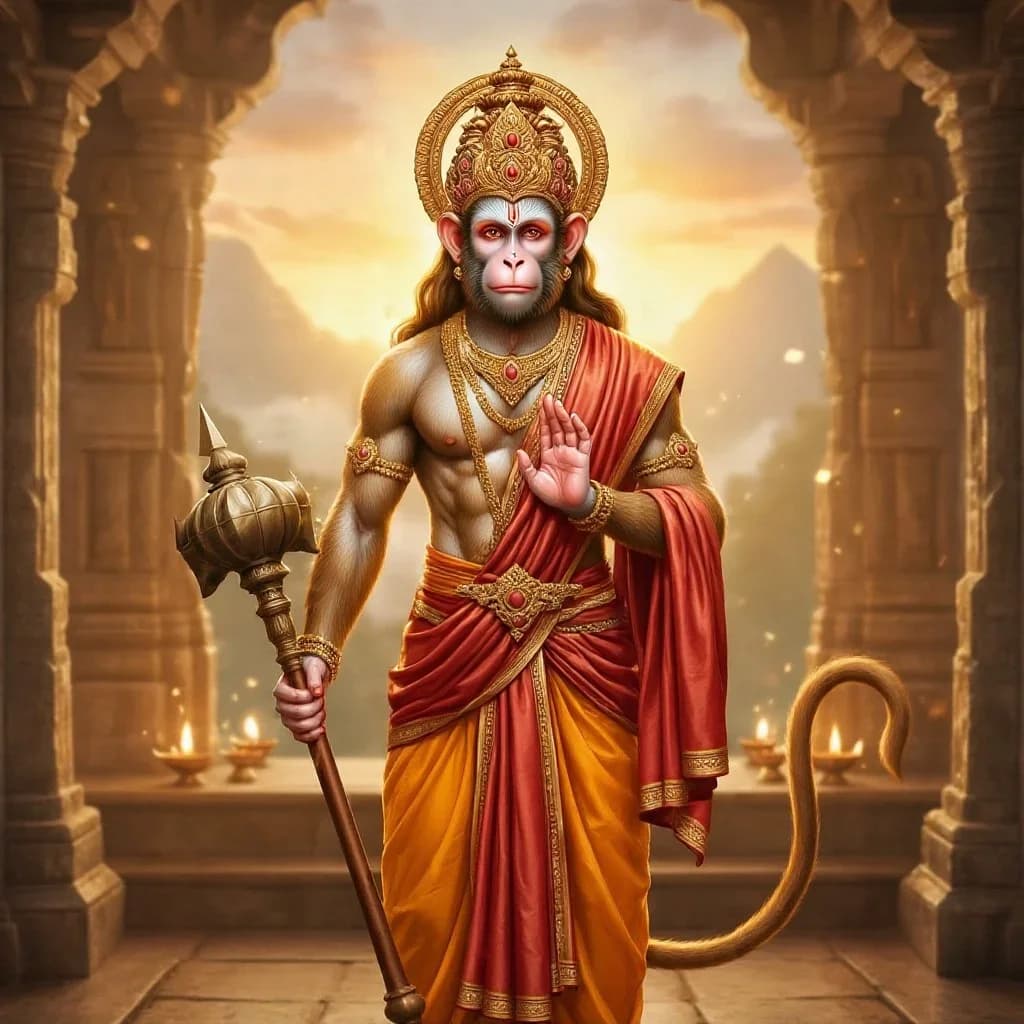
Doha
श्रीगुरु चरन सरोज रज निज मनु मुकुरु सुधारि । बरनउँ रघुबर बिमल जसु जो दायकु फल चारि ॥
बुद्धिहीन तनु जानिके सुमिरौं पवन-कुमार । बल बुधि बिद्या देहु मोहिं हरहु कलेस बिकार ॥
śrīguru carana saroja raja nija manu mukuru sudhāri. baranaüm̐ raghubara bimala jasu jo dāyaku phala cāri.
buddhihīna tanu jānike sumirauṃ pavana-kumāra. bala budhi bidyā dehu mohiṃ harahu kalesa bikāra.
चौपाई / Chaupai
जय हनुमान ज्ञान गुन सागर । जय कपीस तिहुँ लोक उजागर ॥१॥ jaya hanumāna jñāna guna sāgara. jaya kapīsa tihum̐ loka ujāgara.
राम दूत अतुलित बल धामा । अञ्जनि-पुत्र पवनसुत नामा ॥२॥ rāma dūta atulita bala dhāmā. añjani-putra pavanasuta nāmā.
महाबीर बिक्रम बजरङ्गी । कुमति निवार सुमति के सङ्गी ॥३॥ mahābīra bikrama bajaraṅgī. kumati nivāra sumati ke saṅgī.
कञ्चन बरन बिराज सुबेसा । कानन कुण्डल कुञ्चित केसा ॥४॥ kañcana barana birāja subesā. kānana kuṇḍala kuñcita kesā.
हाथ बज्र औ ध्वजा बिराजै । काँधे मूँज जनेउ साजै ॥५॥ hātha bajra au dhvajā birājai. kām̐dhe mūm̐ja janeu sājai.
सङ्कर सुवन केसरीनन्दन । तेज प्रताप महा जग बन्दन ॥६॥ saṅkara suvana kesarīnandana. teja pratāpa mahā jaga bandana.
बिद्यावान गुनी अति चातुर । राम काज करिबे को आतुर ॥७॥ bidyāvāna gunī ati cātura. rāma kāja karibe ko ātura.
प्रभु चरित्र सुनिबे को रसिया । राम लखन सीता मन बसिया ॥८॥ prabhu caritra sunibe ko rasiyā. rāma lakhana sītā mana basiyā.
सूक्ष्म रूप धरि सियहिं दिखावा । बिकट रूप धरि लङ्क जरावा ॥९॥ sūkṣma rūpa dhari siyahiṃ dikhāvā. bikaṭa rūpa dhari laṅka jarāvā.
भीम रूप धरि असुर सँहारे । रामचन्द्र के काज सँवारे ॥१०॥ bhīma rūpa dhari asura sam̐hāre. rāmacandra ke kāja sam̐vāre.
लाय सञ्जीवन लखन जियाये । श्रीरघुबीर हरषि उर लाये ॥११॥ lāya sañjīvana lakhana jiyāye. śrīraghubīra haraṣi ura lāye.
रघुपति कीह्नी बहुत बड़ाई । तुम मम प्रिय भरतहि सम भाई ॥१२॥ raghupati kīhnī bahuta bar̤āī. tuma mama priya bharatahi sama bhāī.
सहस बदन तुह्मारो जस गावैं । अस कहि श्रीपति कण्ठ लगावैं ॥१३॥ sahasa badana tuhmāro jasa gāvaiṃ. asa kahi śrīpati kaṇṭha lagāvaiṃ.
सनकादिक ब्रह्मादि मुनीसा । नारद सारद सहित अहीसा ॥१४॥ sanakādika brahmādi munīsā. nārada sārada sahita ahīsā.
जम कुबेर दिगपाल जहाँ ते । कबि कोबिद कहि सके कहाँ ते ॥१५॥ jama kubera digapāla jahām̐ te. kabi kobida kahi sake kahām̐ te.
तुम उपकार सुग्रीवहिं कीह्ना । राम मिलाय राज पद दीह्ना ॥१६॥ tuma upakāra sugrīvahiṃ kīhnā. rāma milāya rāja pada dīhnā.
तुह्मरो मन्त्र बिभीषन माना । लङ्केस्वर भए सब जग जाना ॥१७॥ tuhmaro mantra bibhīṣana mānā. laṅkesvara bhae saba jaga jānā.
जुग सहस्र जोजन पर भानु । लील्यो ताहि मधुर फल जानू ॥१८॥ juga sahasra jojana para bhānu. līlyo tāhi madhura phala jānū.
प्रभु मुद्रिका मेलि मुख माहीं । जलधि लाँघि गये अचरज नाहीं ॥१९॥ prabhu mudrikā meli mukha māhīṃ. jaladhi lām̐ghi gaye acaraja nāhīṃ.
दुर्गम काज जगत के जेते । सुगम अनुग्रह तुह्मरे तेते ॥२०॥ durgama kāja jagata ke jete. sugama anugraha tuhmare tete.
राम दुआरे तुम रखवारे । होत न आज्ञा बिनु पैसारे ॥२१॥ rāma duāre tuma rakhavāre. hota na ājñā binu paisāre.
सब सुख लहै तुह्मारी सरना । तुम रच्छक काहू को डर ना ॥२२॥ saba sukha lahai tuhmārī saranā. tuma racchaka kāhū ko ḍara nā.
आपन तेज सह्मारो आपै । तीनों लोक हाँक तें काँपै ॥२३॥ āpana teja sahmāro āpai. tīnoṃ loka hām̐ka teṃ kām̐pai.
भूत पिसाच निकट नहिं आवै । महाबीर जब नाम सुनावै ॥२४॥ bhūta pisāca nikaṭa nahiṃ āvai. mahābīra jaba nāma sunāvai.
नासै रोग हरै सब पीरा । जपत निरन्तर हनुमत बीरा ॥२५॥ nāsai roga harai saba pīrā. japata nirantara hanumata bīrā.
सङ्कट तें हनुमान छुड़ावै । मन क्रम बचन ध्यान जो लावै ॥२६॥ saṅkaṭa teṃ hanumāna chur̤āvai. mana krama bacana dhyāna jo lāvai.
सब पर राम तपस्वी राजा । तिन के काज सकल तुम साजा ॥२७॥ saba para rāma tapasvī rājā. tina ke kāja sakala tuma sājā.
और मनोरथ जो कोई लावै । सोइ अमित जीवन फल पावै ॥२८॥ aura manoratha jo koī lāvai. soi amita jīvana phala pāvai.
चारों जुग परताप तुम्हारा । है परसिद्ध जगत उजियारा ॥२९॥ cāroṃ juga paratāpa tumhārā. hai parasiddha jagata ujiyārā.
साधु संत के तुम रखवारे । असुर निकंदन राम दुलारे ॥३०॥ sādhu santa ke tuma rakhavāre. asura nikandana rāma dulāre.
अष्ट सिद्धि नौ निधि के दाता । अस बर दीन जानकी माता ॥३१॥ aṣṭa siddhi nau nidhi ke dātā. asa bara dīna jānakī mātā.
राम रसायन तुम्हरे पासा । सदा रहो रघुपति के दासा ॥३२॥ rāma rasāyana tumhare pāsā. sadā raho raghupati ke dāsā.
तुम्हरे भजन राम को पावै । जनम जनम के दुख बिसरावै ॥३३॥ tumhare bhajana rāma ko pāvai. janama janama ke dukha bisarāvai.
अन्त काल रघुबर पुर जाई । जहाँ जन्म हरिभक्त कहाई ॥३४॥ anta kāla raghubara pura jāī. jahām̐ janma haribhakta kahāī.
और देवता चित्त न धरई । हनुमत सेइ सर्ब सुख करई ॥३५॥ aura devatā citta na dharaī. hanumata sei sarba sukha karaī.
सङ्कट कटै मिटै सब पीरा । जो सुमिरै हनुमत बलबीरा ॥३६॥ saṅkaṭa kaṭai miṭai saba pīrā. jo sumirai hanumata balabīrā.
जय जय जय हनुमान गोसाईं । कृपा करहु गुरुदेव की नाईं ॥३७॥ jaya jaya jaya hanumāna gosāīṃ. kṛpā karahu gurudeva kī nāīṃ.
जो सत बार पाठ कर कोई । छूटहि बन्दि महा सुख होई ॥३८॥ jo sata bāra pāṭha kara koī. chūṭahi bandi mahā sukha hoī.
जो यह पढ़ै हनुमान चालीसा । होय सिद्धि साखी गौरीसा ॥३९॥ jo yaha par̤hai hanumāna cālīsā. hoya siddhi sākhī gaurīsā.
तुलसीदास सदा हरि चेरा । कीजै नाथ हृदय महँ डेरा ॥४०॥ tulasīdāsa sadā hari cerā. kījai nātha hṛdaya maham̐ ḍerā.
दोहा / Closing Doha
पवनतनय सङ्कट हरन मङ्गल मूरति रूप । राम लखन सीता सहित हृदय बसहु सुर भूप ॥
pavanatanaya saṅkaṭa harana maṅgala mūrati rūpa. rāma lakhana sītā sahita hṛdaya basahu sura bhūpa.
Meaning & interpretation, verse by verse
With the full recitation given above, here is an original English meaning for each verse — read as a devotional interpretation rather than a strict word-for-word crib.
Opening doha
Taking the dust from the guru's lotus feet to polish the mirror of the mind, the poet sets out to tell of Rama's spotless glory — the fame that grants the four fruits of life: dharma, artha, kāma and mokṣa. Aware that this body carries little wisdom of its own, he turns his thought toward the son of the wind. Grant me strength, understanding and learning, Hanuman, and lift away my sorrow and every flaw.
Chaupai 1–10 — Hanuman's form, learning and strength
Hail Hanuman, a very ocean of knowledge and virtue; hail the lord among monkeys whose brightness reaches all three worlds. Rama's own messenger, a dwelling-place of strength beyond measure — Anjani's son, known too as the wind's child. Great in valour, built as if of thunder itself, you clear away confused thinking and stay close to those who reason rightly. Golden in hue, finely adorned, earrings swinging and hair in curls — your form itself carries a kind of grace. In your hand rest the mace and the banner; across your shoulder, the sacred thread sits in quiet dignity. Held as Shankara's own emanation and Kesari's beloved son, your radiance and might draw the reverence of the whole world. Deeply learned, richly virtuous, quick of understanding — and always restless to take up Rama's work. You delight simply in hearing of the Lord's life and deeds; Rama, Lakshmana and Sita have made a home within your heart. You took the smallest of forms to appear before Sita unseen, then the most fearsome of forms to set Lanka ablaze. In a form like Bhima's own, you brought down the demons, carrying Rama's purpose through to completion.
Chaupai 11–20 — service to Rama, and Lakshmana restored 11. You carried back the life-giving herb and Lakshmana breathed again; Rama, overjoyed, drew you close to his heart. 12. Rama praised you then without measure, calling you a brother as dear to him as Bharata himself. 13. "Even the thousand-headed serpent sings of your glory," Rama said, drawing you to him as he spoke. 14. Sanaka and the sages born like him, Brahma and the great seers, Narada, Sharada, and the lord of serpents — all recount your praise. 15. Yama, Kubera, the guardians of every direction — and even the finest poets and scholars — find themselves short of words before your greatness. 16. You did Sugriva a service beyond price, bringing him to Rama and, through that meeting, his kingdom returned to him. 17. On your counsel Vibhishana acted, and the whole world came to know him as Lanka's rightful lord. 18. The sun, though set thousands of leagues away, you once took for a sweet fruit and swallowed whole. 19. Keeping the Lord's own ring safe in your mouth, you crossed the ocean — a feat that, for you, was no wonder at all. 20. Whatever tasks this world holds to be impossible turn simple the moment your grace touches them.
Chaupai 21–30 — refuge, protection and fearlessness 21. You keep watch at Rama's own gate; without your leave, no one passes through. 22. Whoever takes shelter under you finds every comfort there; with you as guardian, there is nothing left to fear. 23. Your own power is yours alone to hold in check — a single roar of yours sets all three worlds trembling. 24. No spirit or unseen harm dares come close once your name, great hero, is spoken aloud. 25. Illness fades and every ache eases for the one who keeps your name, brave Hanuman, steadily on their lips. 26. Hanuman lifts away distress from anyone who turns to you fully — in thought, in deed, and in word. 27. Rama stands above every king as the great ascetic-sovereign, and it is you who carried every one of his undertakings through. 28. Whoever comes to you with any sincere wish receives, in turn, a fruit of life beyond measuring. 29. Your splendour has carried through all four ages; the whole world knows it as a light freely shown. 30. You stand guard over the saintly and the devoted, uprooting cruelty wherever it grows — dear as you are to Rama.
Chaupai 31–40 — grace, devotion and the closing plea 31. Mother Janaki granted you this very blessing — that you might, in turn, grant the eight powers and the nine treasures to those who deserve them. 32. The very essence of devotion to Rama rests with you; may you remain, always, the devoted servant of Raghupati. 33. Through devotion to you, one comes to Rama himself, and the sorrows carried across many lifetimes are set down at last. 34. At the last hour, one journeys to Raghubar's own city, taking birth there simply known as a devotee of Hari. 35. There is no need to set the mind on any other divinity — service to Hanuman alone brings every happiness. 36. Trouble is cut away and every pain dissolves for whoever calls to mind Hanuman, the strong and steadfast. 37. Victory, victory, victory to you, Hanuman, our master — grant your grace as freely as a guru would. 38. Whoever recites this a hundred times over is freed from what binds them and comes to know a deep and lasting ease. 39. Whoever reads this Hanuman Chalisa attains fulfilment — and Gaurisha himself stands witness to it. 40. Tulsidas remains, always, Hari's servant — Lord, make your dwelling within this heart.
Closing doha Son of the wind, remover of distress, form itself of blessing and grace — dwell in this heart, lord among gods, together with Rama, Lakshmana and Sita.
A hymn carried in memory before it is carried on paper
Ask most Hindu households in North India, or across Nepal's own Rama and Hanuman temples, how they first learned the Hanuman Chalisa, and few will say "from a book." It travels by ear — from a grandmother's morning recitation, a temple loudspeaker on a Tuesday, a father humming it on a long drive. This piece sets the text down in full first, exactly as it is chanted, before turning to its meaning, its origin and its place in ordinary devotion.
Origin: Tulsidas and the Awadhi verses of the sixteenth century
The Hanuman Chalisa is attributed to Goswami Tulsidas, the Bhakti-era poet-saint generally placed in the sixteenth and early seventeenth centuries, and best known for the Ramcharitmanas, his Awadhi retelling of the Rama story. The Chalisa is composed in that same Awadhi dialect of Hindi rather than in Sanskrit, which is part of why it has travelled so easily into ordinary speech and everyday devotion across the subcontinent.
A well-known account holds that Tulsidas composed the hymn while imprisoned, and that Hanuman's intervention secured his release. This makes for a moving story, and it is worth telling as the tradition tells it — but it belongs to hagiography and oral memory rather than to verified historical record, and it should be read as a devotional account of the hymn's origin rather than a documented biographical fact. What can be said with more confidence is simpler: the text belongs to the Bhakti movement's larger turn toward vernacular devotion, addressed directly to a deity in the language people actually spoke.
Why "chalisa"? The shape of the text
Chālīs means forty in Hindi, and the chālīsā takes its name from its forty chaupais — four-line verses in a shared metre. Around this core sit two opening dohas (couplets) that ask for clarity and grace before the recitation begins, and a closing doha that asks for Hanuman's presence in the heart. Counted together, the hymn runs to forty-three verses, though "chalisa" properly names only the forty at its centre.
Tradition further reads a shape inside that count: the earlier verses are usually understood as a description of Hanuman's form, learning and strength; the following ones turn to his service to Rama, including his part in reviving Lakshmana; and the later verses turn toward the devotee's own request — protection, ease from difficulty, and Hanuman's grace. This grouping, used above to organise the meanings, is a traditional way of reading the hymn's movement, not a division marked in the verses themselves, and readers will find it described with slightly different verse boundaries from one commentary to the next.
Reading the hymn as a whole
Set side by side, the four movements trace a fairly simple arc: who Hanuman is, what he did, why he can be trusted, and what the reciter now asks of him. That arc is worth noticing because it changes how the hymn is usually read — not as forty separate blessings to be collected, but as a single relationship being built verse by verse, from description, to gratitude, to request. The famous images along the way (swallowing the sun for a fruit, carrying a mountain of medicinal herb, crossing the ocean with a ring in the mouth) are traditionally read less as historical claims to be verified and more as ways of saying, in narrative form, that devotion of Hanuman's kind is without limit. A reader can hold both things at once: the story as it is told, and the quality of trust and effort it is pointing toward.
Spiritual and traditional significance
Within Hindu devotional life, the Hanuman Chalisa occupies an unusually accessible place. It asks nothing of the reciter beyond attention and sincerity, and it is recited in homes, temples and moving vehicles as readily as in formal worship. Tuesday and Saturday are widely observed as days associated with Hanuman, and recitation on those days — or, for many households, every single morning — is common practice. Its closing verses, which speak of protection from difficulty and of relief for the fearful, are part of why the hymn is so often reached for at moments of worry, before a journey, or before an undertaking whose outcome feels uncertain.
Tulsidas himself is remembered as having built the Sankat Mochan Hanuman temple in Varanasi, and that name — Sankat Mochan, remover of difficulty — echoes directly in the hymn's own language of release from trouble. Whether read as sacred history or as devotional memory, the connection between the poet's life and the temple's name is part of why the Chalisa is so often the first hymn a household in the Hindu world commits to memory.
Practice note. The text above omits the finer marks used for precise Awadhi pronunciation in scholarly transliteration, and is offered here for reading, study and personal devotion. For guidance on pronunciation, rhythm, and the etiquette of formal recitation, it is worth learning directly from someone within the tradition — a family elder, a priest, or a teacher who recites it regularly.
Key idea. The hymn moves from description to gratitude to request, and its best-known images of impossible strength are traditionally read as devotional language for boundless devotion — not as claims to be checked against ordinary fact.
Sources & references
Hanuman Chalisa — Wikipedia, for the hymn's structure, traditional verse groupings, and general background.
Shri Hanuman Chalisa, Devanagari, transliteration and verse numbering — Shlokam.org, used to verify the Devanagari and transliteration reproduced above.
Śrī Hanumān Chālīsā booklet, Vedanta Society of Southern California, with English translation by Philip Lutgendorf, for background on the hymn's dohas and chaupai structure.
Hanuman Chalisa — All 40 Chaupais, BhaktiBharat, for the traditional account of Tulsidas's authorship and the hymn's association with Tuesday and Saturday observance.