Before you begin
This is Part One of our Gayatri sādhana series: the opening preparations, from approaching the āsana to invoking Śrī Gaṇeśa. Move through the steps in order, allowing the spoken mantra and the accompanying action to receive equal attention.
Keep a clean āsana, drinking-quality water in a small vessel, a spoon, a separate bowl for discarded water, and a ghee lamp with a cotton wick ready before you sit. Arrange the lamp on a stable, heat-resistant surface away from the cloth of your seat.
Note
This article records the opening sequence supplied for this journal, with the texts checked against the references below. It combines practices that occur in different pūjā traditions; it is not presented as a universal tantric paddhati or the complete Gayatri sādhana. Where your received method differs, retain its wording and gestures.
Easy pronunciation · approximate
Read Sanskrit first, then the Roman line. In IAST, ā, ī and ū are long vowels; ś and ṣ are sh-like sounds; ṇ, ṭ and ḍ are retroflex consonants; ṃ marks a nasal sound and ḥ a light breath. The easy lines use aa, ee and oo for long vowels. In ph, pronounce p with a breath, not the English f. These aids do not encode Vedic pitch accents.
01 · Approach the āsana
Sanskrit
ह्रीं अस्त्राय फट् ।
Roman transliteration · IAST
Hrīṃ astrāya phaṭ.
Easy pronunciation · approximate
Hreem as-traa-ya phat. Keep the ee and aa long; end phaṭ with an aspirated p and a crisp retroflex ṭ.
Action
As you approach your āsana, recite this formula three times, as specified in this sequence. Then sit steadily and let the body settle.
Note
The formula and the three repetitions here follow the author’s supplied practice. No additional prefix, clapping, directional gesture or seat-purification rite has been added.
02 · Śuddhi — sprinkle water
Sanskrit
ॐ अपवित्रः पवित्रो वा सर्वावस्थां गतोऽपि वा । यः स्मरेत् पुण्डरीकाक्षं स बाह्याभ्यन्तरः शुचिः ॥
Roman transliteration · IAST
Oṃ apavitraḥ pavitro vā sarvāvasthāṃ gato’pi vā. Yaḥ smaret puṇḍarīkākṣaṃ sa bāhyābhyantaraḥ śuciḥ.
Easy pronunciation · approximate
Om a-pa-vi-trah pa-vi-tro vaa, sar-vaa-vas-thaam ga-to-pi vaa. Yah sma-ret pun-da-ree-kaak-sham, sa baah-yaabh-yan-ta-rah shu-chih.
Action
While reciting, sprinkle a little clean water over yourself. Keep the action light and attentive; the verse accompanies remembrance, not merely the movement of water.
Meaning
Whether impure or pure, whatever one’s condition, one who remembers Puṇḍarīkākṣa—the lotus-eyed Lord—is described as pure outwardly and inwardly.
Note
This is the complete two-line śuddhi verse. Some manuals add “punātu puṇḍarīkākṣaḥ” afterward; that is an additional formula, rather than a missing line of this verse.
03 · Ācamana — three sips and cleansing
Sanskrit
ॐ केशवाय नमः । ॐ नारायणाय नमः । ॐ माधवाय नमः । ॐ पुण्डरीकाक्षाय नमः ।
Roman transliteration · IAST
Oṃ keśavāya namaḥ. Oṃ nārāyaṇāya namaḥ. Oṃ mādhavāya namaḥ. Oṃ puṇḍarīkākṣāya namaḥ.
Easy pronunciation · approximate
Om ke-sha-vaa-ya na-mah. Om naa-raa-ya-naa-ya na-mah. Om maa-dha-vaa-ya na-mah. Om pun-da-ree-kaak-shaa-ya na-mah.
Action
Take a small amount of clean drinking water into the right palm and sip with the first name. Repeat with fresh small amounts for the second and third names. The fourth name is kept here as a concluding salutation while cleansing the hands over the separate bowl; it is not an instruction for a fourth sip.
Note
The names and their order above preserve the sequence supplied for this article. Ācamana manuals differ in the names, order, use of namaḥ or svāhā, and the concluding hand-cleansing formula. Follow your own paddhati for those details.
04 · Dīpa — light the ghee lamp
Sanskrit
ॐ अग्निर्ज्योतिर्ज्योतिरग्निः स्वाहा । सूर्यो ज्योतिर्ज्योतिः सूर्यः स्वाहा । अग्निर्वर्चो ज्योतिर्वर्चः स्वाहा । सूर्यो वर्चो ज्योतिर्वर्चः स्वाहा । ज्योतिः सूर्यः सूर्यो ज्योतिः स्वाहा ॥
Roman transliteration · IAST
Oṃ agnir jyotir jyotir agniḥ svāhā. Sūryo jyotir jyotiḥ sūryaḥ svāhā. Agnir varco jyotir varcaḥ svāhā. Sūryo varco jyotir varcaḥ svāhā. Jyotiḥ sūryaḥ sūryo jyotiḥ svāhā.
Easy pronunciation · approximate
Om ag-nir jyo-tir jyo-tir ag-nih swaa-haa. Soor-yo jyo-tir jyo-tih soor-yah swaa-haa. Ag-nir var-cho jyo-tir var-chah swaa-haa. Soor-yo var-cho jyo-tir var-chah swaa-haa. Jyo-tih soor-yah soor-yo jyo-tih swaa-haa.
Action
Light the ghee-soaked wick and recite the lamp prayer with attention to its light. Keep the lamp safely beside the practice space and away from splashed water; do not leave the burning lamp unattended.
Meaning
The prayer honours light and splendour through Agni and Sūrya. The remembered phrase “agnivarcho jyoti varcho” corresponds to “agnir varco jyotir varcaḥ,” the third line printed here.
Note
This five-line form is given under Dīpa Pūjana in A Manual of Hindu Marriage, printed page 19. Its Agni and Sūrya formulas also appear in Vedic fire-ritual contexts; their use here is the lamp-prayer application recorded by that manual, not a claim that all Gayatri traditions use this exact form.
05 · Invoke Śrī Gaṇeśa
Sanskrit
ॐ गं गणपतये नमः ।
Roman transliteration · IAST
Oṃ gaṃ gaṇapataye namaḥ.
Easy pronunciation · approximate
Om gam ga-na-pa-ta-ye na-mah. The ṃ in gaṃ is nasal; the ṇ in gaṇapataye is retroflex. The short a sounds are not the English word “game.”
Action
Bring your attention to Śrī Gaṇeśa and recite the mantra reverently. Its simple sense is “Salutations to Gaṇapati.” The mantra is attested in the Gaṇapati Atharvaśīrṣa, verse 7. No fixed japa count is prescribed in this opening section.
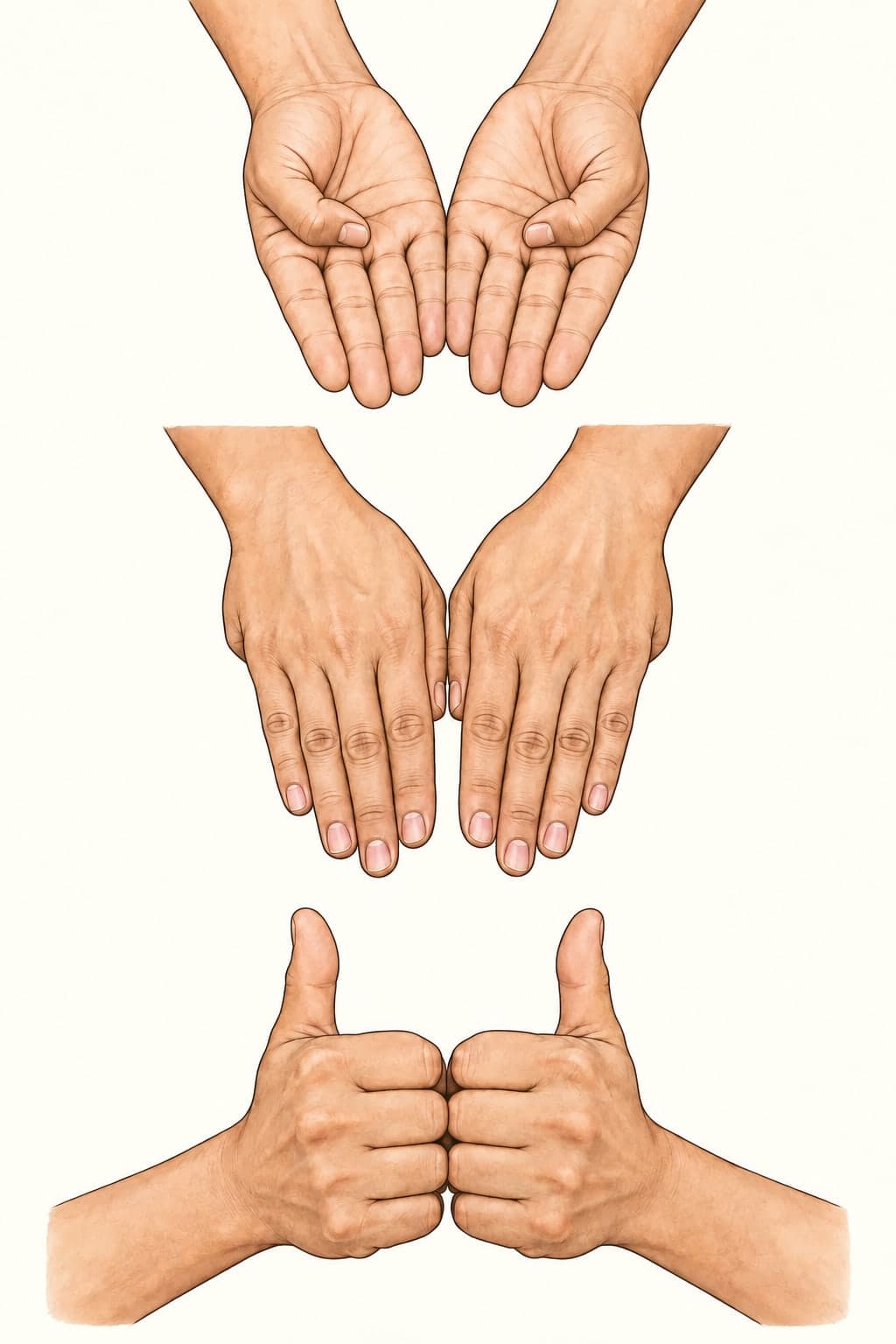
The three gestures below are a documented opening invocation sequence: invitation, establishment and presence. They are general pūjā mudrās, usable in Gaṇeśa worship, rather than a uniquely Gaṇeśa-specific set. They are the closest match to the three gestures recalled for this article; the exact lineage set has not been identified.
05a · आवाहनी मुद्रा — Āvāhanī mudrā
Roman transliteration · IAST
Āvāhanī mudrā.
Easy pronunciation · approximate
Aa-vaa-ha-nee mud-raa.
Action
Bring the hands together in a gently cupped offering gesture, palms facing upward. Bend each thumb inward toward the base of its own ring finger. Hold the gesture without strain as you inwardly invite Śrī Gaṇeśa to receive the worship.
Meaning
Āvāhana means invitation. This is the first, palms-up gesture in the illustration.
05b · स्थापनी मुद्रा — Sthāpanī mudrā
Roman transliteration · IAST
Sthāpanī mudrā.
Easy pronunciation · approximate
Sthaa-pa-nee mud-raa.
Action
From the preceding hand arrangement, turn the palms downward, keeping the hands alongside one another and the thumbs folded inward. Let the gesture express offering a place for the deity’s presence.
Meaning
Sthāpana means establishment. This is the middle, palms-down gesture in the illustration.
05c · सन्निधापनी मुद्रा — Sannidhāpanī mudrā
Roman transliteration · IAST
Sannidhāpanī mudrā.
Easy pronunciation · approximate
San-ni-dhaa-pa-nee mud-raa.
Action
Close both hands into relaxed fists, bring the fists together, and extend both thumbs upward outside the fists. Maintain a quiet inward request for the deity’s presence during worship.
Meaning
This gesture accompanies the request for nearness or presence. It is the bottom gesture in the illustration. Keeping the thumbs raised distinguishes it from the related closed-thumb gesture of sannirodhinī.
Note
Finger placement follows the invocation-mudrā description reproduced in the Puraścaraṇārṇava reference, with visual comparison to Agama Academy’s named diagrams. Some teaching traditions use different thumb placement. The illustration is a study aid; it does not establish which version your lineage follows.
The close of Part One
This instalment ends with the invocation of Śrī Gaṇeśa. The subsequent stages of Gayatri sādhana will be written separately, so that each mantra, gesture and action can be studied in its proper place.
Sources & references
- All World Gayatri Pariwar, Karmakand Pradip: pavitrīkaraṇa verse and sprinkling-water practice.
- A Manual of Hindu Marriage, printed page 19: full Dīpa Pūjana prayer.
- Vājasaneyi Saṃhitā, chapter 3: Agni and Sūrya light formulas.
- Gaṇapati Atharvaśīrṣa, verse 7: Oṃ gaṃ gaṇapataye namaḥ.
- Puraścaraṇārṇava, discussion of invocation gestures at printed page 220, reproduced by Yoga Vidya.
- Agama Academy: named Āvāhanī, Sthāpana and Sannidhāpanī visual references.
Editorial source: the author supplied the sequence, the threefold hrīṃ astrāya phaṭ formula, and the four ācamana names. The references above verify particular texts and gestures, not the entire sequence as a single transmitted paddhati.